

Trump’s State Visit to China: A Major Diplomatic Moment in Global Politics
Trump’s State Visit to China: A Major Diplomatic Moment in Global Politics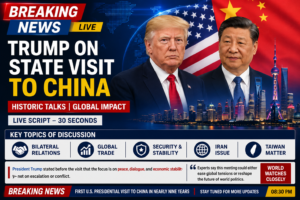
U.S. President Donald Trump is currently on a state visit to China, where he is holding high-level meetings with Chinese President Xi Jinping. This marks the first official visit by a sitting U.S. president to China in nearly nine years, and it is being widely viewed as a significant development in international diplomacy.
The visit comes at a time when the world is facing heightened geopolitical tensions, economic uncertainty, and growing strategic competition among major powers. Relations between the United States and China continue to play a central role in shaping global trade, technology, defense, and international security.
Ahead of the visit, President Trump clarified that the issue of Iran is not linked to this trip. According to him, the visit is focused on bilateral relations, global economic stability, and security cooperation rather than the start of any new conflict. He also praised Pakistan Pakistan, highlighting its positive diplomatic role in certain regional matters and its efforts in facilitating dialogue.
The visit follows last year’s diplomatic engagement when the Chinese President visited the United States in an effort to improve bilateral relations. However, global conditions have since become more complex, with rising tensions across multiple regions, making the current meeting even more significant.
Key global issues such as the Iran crisis, Middle East instability, the Ukraine conflict, tensions in the South China Sea, the Taiwan issue, and disruptions in global supply chains form the backdrop of these discussions. Among these, Taiwan and Iran are considered the most sensitive and strategically important topics.
Economically, the meeting is crucial for global markets. Any improvement in U.S.–China relations could boost investor confidence, stabilize financial markets, and improve global trade flows. On the other hand, continued tensions could increase volatility and economic uncertainty worldwide.
Europe, Russia, the Middle East, and Asian countries are closely watching the visit, as its outcomes are expected to have a direct impact on global politics, energy markets, and international security structures.
Overall, this state visit reflects a world entering a new phase where direct engagement between major powers plays a decisive role in shaping the global order, and where outcomes of such meetings can influence international stability for years to come.
