
A New Race for the World’s Top Diplomat: Inside the 2025–2026 UN Secretary-General Election
A New Race for the World’s Top Diplomat: Inside the 2025–2026 UN Secretary-General Election
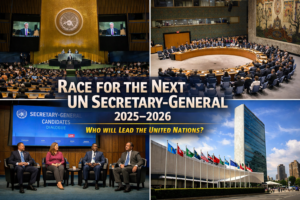
In the grand halls of the United Nations, a quiet but consequential political contest has begun—one that will shape global diplomacy for years to come. The race to select the next Secretary-General is underway, guided by renewed commitments to transparency, inclusivity, and global engagement.
The Opening Move
On 25 November 2025, a formal joint letter from the Presidents of the General Assembly and the Security Council set the process in motion. Rooted in Article 97 of the UN Charter and reinforced by General Assembly Resolution 79/327, the process marks a continuation of reforms aimed at making the selection more open than ever before.
Member States were invited to nominate candidates—each required to submit not just their name, but a vision for the future, a detailed CV, and disclosures on campaign financing. The goal: ensure that the world’s top diplomatic post is filled through a process the global public can observe and trust.
The Candidates Emerge
By early 2026, several prominent figures stepped forward:
- Michelle Bachelet Jeria, former President of Chile, initially backed by Chile, Brazil, and Mexico. Her candidacy, however, was later withdrawn in March 2026.
- Virginia Gamba, nominated by the Maldives, also withdrew her candidacy the same month.
- Rafael Mariano Grossi, Argentina’s nominee and a seasoned diplomat in nuclear governance, remains a strong contender.
- Rebeca Grynspan Mayufis of Costa Rica, known for her work in international development and economic policy.
- Macky Sall, former President of Senegal, bringing political leadership experience from Africa.
Each candidate represents not just a nation, but a vision for addressing global crises—from climate change to conflict resolution.
Democracy on Display: Public Dialogues
In a move that reflects the UN’s push for openness, the General Assembly scheduled live, webcast “interactive dialogues” with the candidates on 21 and 22 April 2026. Broadcast on UN WebTV, these sessions allow Member States—and the global public—to hear directly from those vying for the role.
The schedule reads like a diplomatic debate series:
- 21 April:
- Morning: Michelle Bachelet (prior to withdrawal)
- Afternoon: Rafael Grossi
- 22 April:
- Morning: Rebeca Grynspan
- Afternoon: Macky Sall
These dialogues are more than formalities—they are moments where candidates outline their priorities, respond to questions, and attempt to build global consensus.
Behind the Scenes
While the process appears open, the real decision will ultimately hinge on negotiations within the Security Council, whose recommendation is required before the General Assembly makes the final appointment. Diplomacy, alliances, and geopolitical balance will all play decisive roles.
A Turning Point for Global Leadership
This election is not just about choosing an individual—it’s about defining the direction of international cooperation in a time of uncertainty. With reforms pushing for greater transparency and participation, the 2025–2026 selection process could mark a new era in how global leadership is chosen.
As the world watches, one question looms: who will emerge as the next voice of international diplomacy?
