

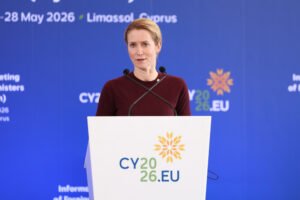
EU Vice-President , Kaja Kallas, to Pakistan
- The visit of European Union High Representative for Foreign Affairs and Security Policy and Vice-President of the European Commission, Kaja Kallas, to Pakistan
 is far more than a routine diplomatic engagement. At a time when the international system is being reshaped by geopolitical competition, economic uncertainty, climate crises, and regional conflicts, the arrival of the EU’s top diplomat in Islamabad carries significant political and strategic weight. It reflects not only the growing importance of Pakistan-EU relations but also the recognition on both sides that their partnership must evolve to address the challenges of a rapidly changing world.
Relations between Pakistan and the European Union have developed considerably over the past several decades. What began primarily as a relationship centered on trade and development cooperation has gradually expanded into a multifaceted partnership encompassing diplomacy, security, climate action, governance, education, and regional stability. This evolution demonstrates a growing understanding that the relationship is no longer defined solely by economic interests but by a broader convergence of strategic concerns.
One of the most important breakthroughs in Pakistan-EU relations came in 2014 when Pakistan secured GSP+ status, granting preferential access to European markets. This milestone significantly boosted Pakistan’s exports and strengthened economic ties between the two sides. For Pakistan, the European Union remains its largest export destination and one of its most important economic partners. At a time when the country is seeking sustainable economic growth, foreign investment, and greater integration into global markets, maintaining and expanding ties with Europe remains a key foreign policy objective.
For the European Union, Pakistan’s significance extends beyond economics. Situated at the crossroads of South Asia, Central Asia, and the Middle East, Pakistan occupies a strategically important position in a region that continues to shape global security dynamics. Issues such as regional stability, counterterrorism, migration, humanitarian assistance, and developments in neighboring Afghanistan make Pakistan an important partner for European policymakers. The EU increasingly recognizes that engagement with Pakistan contributes to its broader objectives of promoting stability and cooperation across a volatile region.
Kaja Kallas’s visit also comes at a particularly important moment in global affairs. The war in Ukraine has transformed Europe’s security outlook, while ongoing tensions in the Middle East, disruptions in global trade routes, and intensifying competition among major powers have created new diplomatic realities. In response, the European Union has sought to strengthen partnerships with influential countries across Asia and the Global South. Pakistan’s growing role in regional diplomacy and its strategic location make it a natural partner in this effort.
Another area that is likely to define the future of Pakistan-EU relations is climate cooperation. Pakistan remains among the countries most vulnerable to climate change despite contributing only a small fraction of global greenhouse gas emissions. The devastating floods of 2022 highlighted the scale of the challenge and reinforced the need for international cooperation. The European Union has emerged as an important partner in supporting climate resilience, disaster recovery, sustainable development, and green energy initiatives. As climate concerns become increasingly central to global policymaking, cooperation in this field may become one of the strongest pillars of the relationship.
The significance of Kaja Kallas’s visit therefore lies not only in the meetings and official statements that will accompany it, but in what it symbolizes. It represents the continued transformation of Pakistan-EU relations from a largely transactional partnership into a more comprehensive strategic relationship. Both sides are increasingly looking beyond immediate interests and focusing on long-term cooperation in trade, investment, security, climate action, connectivity, and multilateral diplomacy.
