

Bangladesh’s Khalilur Rahman Elected President of the 81st UN General Assembly
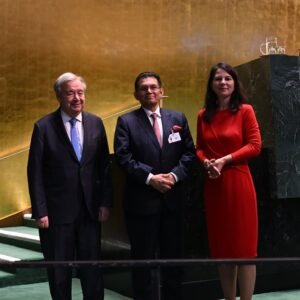
Bangladesh’s Khalilur Rahman Elected President of the 81st UN General Assembly
By Irfan Tariq
United Nations Headquarters, New York | June 2026
Bangladesh has secured a major diplomatic victory with the election of veteran diplomat Khalilur Rahman as President of the 81st Session of the United Nations General Assembly (UNGA), one of the most prominent leadership positions in the multilateral system. In a closely contested vote held at UN Headquarters in New York, Rahman defeated Cyprus’ candidate, Andreas S. Kakouris, to win the presidency for the 2026–2027 session.
According to the official results, all 190 member states participating in the election cast their ballots, with no abstentions recorded. Rahman secured 99 votes, while Kakouris received 91 votes, giving the Bangladeshi diplomat a narrow but decisive victory.
The election was notable because the presidency of the General Assembly is often determined through regional consensus. This year, however, member states were called upon to make a choice through a secret ballot, resulting in one of the most closely watched contests for the office in recent years. The vote took place at a time when the United Nations is confronting multiple global challenges, including armed conflicts, climate change, humanitarian emergencies, economic uncertainty and growing calls for reform of international institutions.
Rahman’s victory is widely viewed as a reflection of Bangladesh’s rising profile on the global stage and its increasingly active role in international diplomacy. A seasoned diplomat and policymaker, he has built a distinguished career in public service and international affairs, earning recognition for his work on development, climate diplomacy, migration, peacebuilding and global governance. His election is being seen not only as a personal achievement but also as an acknowledgment of Bangladesh’s growing influence within the United Nations system.
The outcome carries particular significance for Bangladesh, which will hold the presidency of the General Assembly for only the second time in its history. The first Bangladeshi to occupy the position was Humayun Rashid Choudhury, who presided over the Assembly’s 41st session in 1986–87. Nearly four decades later, Rahman’s election marks another milestone in the country’s diplomatic journey and underscores its expanding role in global affairs.
Although the President of the General Assembly does not exercise executive authority over the United Nations, the office plays a crucial role in steering the work of the Assembly’s 193 member states, facilitating negotiations, building consensus and representing the world body in high-level international engagements. Rahman’s one-year term, which will run from September 2026 to September 2027, is expected to be dominated by discussions on peace and security, sustainable development, climate action, artificial intelligence governance, humanitarian crises and reform of multilateral institutions.
Rahman will succeed Annalena Baerbock, Germany’s former foreign minister and President of the 80th Session of the General Assembly. Baerbock’s tenure has been marked by efforts to defend the UN Charter, strengthen multilateral cooperation and enhance the organization’s response to a range of global crises. The incoming president will inherit an agenda shaped by these challenges while facing growing expectations from member states seeking a more effective and responsive United Nations.
Rahman is scheduled to formally assume office when the 81st Session of the General Assembly opens in September 2026. His presidency will coincide with a pivotal period for the United Nations, including discussions on institutional reform, efforts to accelerate implementation of the Sustainable Development Goals, and preparations surrounding the selection of a successor to Secretary-General António Guterres, whose term is due to conclude at the end of 2026.
With a hard-fought victory of 99 votes to 91, Khalilur Rahman now steps into one of the most visible and influential positions in international diplomacy. For Bangladesh, the election represents a landmark diplomatic achievement; for the United Nations, it brings new leadership at a moment when global cooperation is being tested by some of the most complex challenges of the modern era.
