
Kashmir Exploitation Day: History,
Kashmir Exploitation Day: History,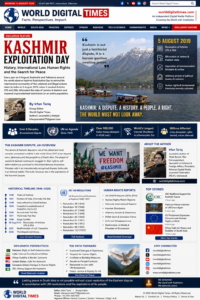 International Law, Human Rights and the Search for Peace
By Irfan Tariq
Group Editor, World Digital Times
Every year on 5 August, Pakistan, Azad Jammu and Kashmir, and millions of Kashmiris across the world observe Kashmir Exploitation Day. The occasion marks the anniversary of India’s constitutional changes of 5 August 2019, when Articles 370 and 35A of the Indian Constitution were revoked, ending the special constitutional status of the former State of Jammu and Kashmir and reorganizing it into two Union Territories.
For Pakistan and many Kashmiris, the day symbolizes the beginning of a new phase of political uncertainty, constitutional change and heightened security measures. India, however, maintains that the decision was a sovereign constitutional reform aimed at strengthening governance, promoting economic development and ensuring equal rights for all citizens.
The differing narratives surrounding 5 August have made the date one of the most debated milestones in South Asian politics.
The Historical Origins of the Kashmir Dispute
The roots of the Kashmir dispute stretch back to 1846, when the Treaty of Amritsar transferred the princely state of Jammu and Kashmir to Maharaja Gulab Singh under British colonial administration.
Following the partition of British India in 1947, Jammu and Kashmir became the center of competing claims by India and Pakistan. After armed conflict broke out, the Maharaja signed the Instrument of Accession to India, a document India regards as the legal basis of its sovereignty over the territory. Pakistan has consistently disputed both the circumstances and the legality of that accession.
The first Indo-Pakistan war ended with a United Nations-brokered ceasefire in 1949, establishing the Ceasefire Line, later known as the Line of Control (LoC).
The United Nations and Kashmir
The Kashmir dispute remains one of the oldest unresolved issues on the agenda of the United Nations Security Council.
Between 1948 and 1957, the Security Council adopted a series of resolutions addressing the conflict. These resolutions called for a ceasefire, demilitarization under specified conditions, and a process through which the people of Jammu and Kashmir could determine their political future. Pakistan views these resolutions as the principal framework for resolving the dispute, while India argues that subsequent bilateral agreements, particularly the Simla Agreement of 1972, established bilateral dialogue as the appropriate path for addressing outstanding issues.
Over the decades, successive UN Secretaries-General have repeatedly encouraged both countries to resolve their differences peacefully through dialogue while respecting international law and human rights.
What Happened on 5 August 2019?
On 5 August 2019, the Government of India revoked the special constitutional provisions contained in Articles 370 and 35A.
The move was accompanied by extensive security deployments, restrictions on movement, communication blackouts, and the detention of numerous political leaders. India defended these measures as temporary steps necessary to maintain law and order and prevent violence.
Pakistan strongly condemned the decision, arguing that it violated international law and could not alter the internationally recognized disputed status of Kashmir.
The constitutional changes significantly reshaped regional diplomacy and intensified tensions between the two nuclear-armed neighbours.
Human Rights Concerns
Following the constitutional changes, several international human rights organizations expressed concern regarding developments in Indian-administered Kashmir.
The Office of the United Nations High Commissioner for Human Rights (OHCHR) published reports highlighting allegations related to restrictions on freedom of expression, prolonged communication shutdowns, arbitrary detentions, excessive use of force, and concerns regarding accountability.
Organizations including Human Rights Watch and Amnesty International also documented concerns regarding civil liberties, press freedom, internet restrictions, and the treatment of journalists, activists, and political leaders.
India has rejected many of these allegations, maintaining that its actions were lawful, proportionate, and necessary to combat terrorism while protecting civilians and restoring normalcy.
International Responses
The international community has generally urged restraint and dialogue rather than confrontation.
The Organisation of Islamic Cooperation (OIC) has repeatedly expressed support for the rights of the Kashmiri people.
The European Union, the United States, the United Kingdom, and other major international actors have consistently encouraged both India and Pakistan to avoid escalation, protect human rights, and pursue peaceful diplomatic engagement.
Meanwhile, China, which also has territorial interests connected to the broader Himalayan region, has closely monitored developments, particularly concerning Ladakh.
A Conflict Beyond Borders
The Kashmir dispute is no longer viewed solely as a bilateral territorial disagreement.
It has significant implications for:
- Regional security in South Asia.
- Nuclear stability between India and Pakistan.
- International diplomacy.
- Human rights protection.
- Water security through the Indus River system.
- Economic development and regional connectivity.
For nearly eight decades, Kashmir has influenced the political and strategic landscape of South Asia more profoundly than any other unresolved territorial dispute in the region.
The Road Ahead
History demonstrates that military confrontation alone has not resolved the Kashmir dispute. Wars in 1947, 1965, 1971, and 1999, along with recurring periods of heightened tension, have failed to produce a lasting political settlement.
Many international observers argue that sustainable peace will require confidence-building measures, continued diplomatic engagement, respect for human rights, and meaningful dialogue between the concerned parties.
Conclusion
Kashmir Exploitation Day serves as a reminder that the Kashmir dispute remains one of the world’s most enduring and sensitive international issues.
While India views the constitutional changes of August 2019 as an internal administrative and constitutional reform, Pakistan and many Kashmiri representatives regard them as inconsistent with the disputed status of the territory and continue to advocate a resolution based on the right to self-determination. International organizations have also raised concerns about the protection of fundamental rights and the humanitarian situation.
Despite these differing positions, one principle commands broad international support: lasting peace in South Asia will depend on dialogue, respect for human rights, regional stability, and sustained diplomatic efforts.
