
UN General Assembly Day One: Diplomacy Amid the Sound of War
UN General Assembly Day One: Diplomacy Amid the Sound of War
Written by Irfan Tariq
The 81st session of the United Nations General Assembly opened in New York on September 22 against a backdrop of wars, regional tensions and deepening diplomatic crises. World leaders arrived with competing national priorities, but the first day quickly became about something larger: how to find a path toward peace in a world increasingly defined by conflict.
The General Assembly chamber witnessed major speeches on international security, regional conflicts and the future of the global order. Yet some of the most significant diplomatic activity took place away from the podium—in sideline meetings, closed-door discussions and direct contacts between countries at the centre of the current crises.
Iran, Palestine, Gaza, Kashmir, Ukraine and the wider Middle East dominated much of the diplomatic conversation.
Trump on Iran: A Hard Warning, but Also a Door to Negotiations
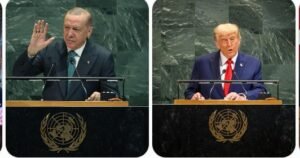
One of the most closely watched moments of the opening day was US President Donald Trump’s address on Iran and the ongoing conflict.
Trump adopted a highly confrontational tone, warning Tehran that the United States could take extremely severe military action if an agreement was not reached. At the same time, however, he left open the possibility of a negotiated settlement and spoke of the prospect of an agreement with Iran.
This created one of the most striking contradictions of the day: a language of military pressure on the public stage, alongside diplomacy behind the scenes.
From a journalistic and peace-oriented perspective, this raises an important question: if the ultimate objective is to end a war, should the emphasis not be placed on strengthening the negotiating table rather than escalating threatening rhetoric?
Military pressure may form part of a state’s strategy, but lasting political settlements ultimately require diplomacy. At a time when the international community is gathered under the roof of the United Nations, keeping channels of communication open is particularly important.
And the most significant development came later.
A Three-Hour US-Iran Meeting
On the very day Trump delivered his tough message, US and Iranian officials held a meeting lasting roughly three hours on the sidelines of the UN gathering.
Trump subsequently described the meeting in positive terms and indicated that another meeting could follow. Although details of the discussions were not made public, the encounter itself was significant.
The sequence was striking: a tough warning from the podium, followed by direct diplomatic engagement behind closed doors.
That suggests that, despite the continuing conflict, diplomacy has not completely disappeared from the equation.
Middle Eastern Leaders Meet on the Sidelines
The US-Iran contact was accompanied by wider regional diplomacy.
Trump also met with a group of Middle Eastern leaders on the sidelines, including Turkish President Recep Tayyip Erdoğan, Jordan’s King Abdullah II, Qatar’s Emir Sheikh Tamim bin Hamad Al Thani and other regional representatives.
Iran, regional security and possible avenues for reducing tensions were among the issues discussed. The meeting underlined an important reality: the Iran crisis is no longer simply a confrontation between Washington and Tehran. Its consequences extend across the Gulf, the Strait of Hormuz, energy markets, maritime trade and the wider security architecture of the Middle East.
This is why the sideline diplomacy at the UN deserves as much attention as the formal speeches. Sometimes the most consequential conversations at an international summit take place away from the main podium.
Kashmir Echoes Through the General Assembly
For Pakistan, another significant moment came when Turkish President Recep Tayyip Erdoğan referred to Kashmir in his General Assembly address.
Erdoğan called for disputes in South Asia, including Kashmir, to be addressed through dialogue and within the framework of the UN Charter and relevant UN resolutions.
The reference came as Pakistan prepared for Prime Minister Shehbaz Sharif’s own address to the General Assembly later in the week.
For Islamabad, Kashmir remains a central foreign-policy issue, and its mention by a major international leader at the UN provided another reminder that the dispute continues to occupy space in international diplomacy.
Palestine and Gaza: Another Powerful Theme
The Palestinian question and the humanitarian crisis in Gaza were also prominent from the opening of the General Assembly.
Erdoğan spoke strongly about Gaza, while Arab and Muslim foreign ministers also discussed the humanitarian situation, aid delivery, reconstruction and the political future of Palestine.
The continuing focus on Gaza reflected broader international concern over the humanitarian consequences of prolonged conflict and the search for a political settlement.
Thus, from the first day itself, Kashmir and Palestine—two long-standing international disputes—once again found their place at the world’s principal diplomatic forum.
Their histories and political circumstances are different, but the repeated emphasis on dialogue, international law and peaceful political solutions remains an important element of the UN discourse surrounding both issues.
Trump’s Special Mention of Pakistan
Pakistan also received a notable mention in President Trump’s address.
Trump referred positively to Prime Minister Shehbaz Sharif and again spoke about his claimed role in the May 2025 Pakistan-India ceasefire. India has previously disputed the extent of the US role in that episode, so the statement should be understood as Trump’s account of events rather than an uncontested description accepted by all sides.
The reference nevertheless placed Pakistan among the countries receiving particular attention during the opening day’s high-level diplomacy.
For Islamabad, the wider regional context is especially important because Pakistan has consistently emphasized dialogue and diplomatic engagement in addressing regional crises, including tensions involving Iran and the broader Middle East.
What Did Day One Really Tell the World?
Viewed as a journalistic account of the opening day, September 22 presented a remarkable picture.
Iran and the United States were talking while threatening language continued.
Middle Eastern leaders were consulting each other while regional tensions remained high.
Kashmir was raised in the General Assembly.
Gaza and Palestine remained at the heart of the international debate.
Pakistan received a significant mention in the US president’s address.
These developments reveal a world caught between two competing impulses: the language of confrontation and the necessity of diplomacy.
The United Nations was created after the devastation of two world wars with the fundamental idea that disputes should be addressed through collective security, international law and peaceful means.
That principle is particularly relevant today.
As a journalist observing the first day of this important UN session, one message stands out: President Trump and all parties involved in the Iran crisis should give greater space to negotiations and diplomacy and avoid rhetoric that could further escalate tensions. The objective should be to find a sustainable political solution that can bring the conflict to an end and reduce the risk of a wider regional war.
The same principle applies more broadly to the crises surrounding Gaza, Palestine, Kashmir, Ukraine and the wider Middle East.
The first day of the 81st General Assembly therefore carried a message that was both troubling and hopeful. Troubling, because wars and threats continue to dominate the international landscape. Hopeful, because despite the harsh rhetoric, the doors of diplomacy remain open.
And perhaps that was the most important sound heard in New York on the opening day—not only the speeches from the world’s leaders, but the quieter conversations taking place in the corridors and meeting rooms, where the search for peace continues.
The real test now is whether these diplomatic contacts will produce concrete steps toward ending wars—or remain only another chapter in the long history of international declarations.
Written by Irfan Tariq
.
