

From Makkah, a new security triangle has emerged.
MAKKAH DEFENCE PACT: THREE POWERS, ONE SHIELD
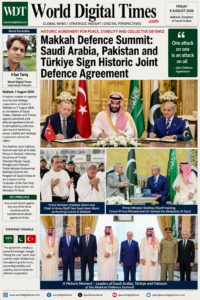
Saudi Arabia, Pakistan and Türkiye Forge Historic Collective Defence Alliance
Makkah | 7 August 2026
A historic new security architecture took shape in the heart of Makkah on 7 August 2026 as Saudi Arabia, Pakistan and Türkiye signed the Makkah Joint Defence Agreement, committing themselves to collective security and declaring that an armed attack against any one of the three states will be regarded as an attack against all.
The landmark agreement was signed at Al-Safa Palace in Makkah during the Makkah Joint Defence Summit, following the arrival of Turkish President Recep Tayyip Erdoğan and Pakistani Prime Minister Muhammad Shehbaz Sharif in the Kingdom of Saudi Arabia at the invitation of the Custodian of the Two Holy Mosques, King Salman bin Abdulaziz Al Saud.
Saudi Crown Prince and Prime Minister Mohammed bin Salman bin Abdulaziz Al Saud received President Erdoğan and Prime Minister Shehbaz Sharif, with the three leaders reviewing the longstanding historical relations among Saudi Arabia, Pakistan and Türkiye and discussing regional and international developments of mutual interest.
The summit culminated in the signing of the Makkah Joint Defence Agreement by Crown Prince Mohammed bin Salman, President Erdoğan and Prime Minister Shehbaz Sharif.
The agreement’s most consequential provision establishes a principle of collective defence: any armed attack against one of the three countries shall be regarded as an attack against all three.
The commitment marks a major elevation of defence cooperation among Riyadh, Islamabad and Ankara, transforming decades of bilateral military relationships into a broader trilateral strategic framework.
A New Strategic Triangle
The agreement brings together three strategically significant Muslim powers whose geographical positions and military capabilities span the Gulf, South Asia, the Middle East and the wider Eurasian region.
Saudi Arabia provides strategic depth in the Gulf, economic power and critical energy infrastructure. Pakistan brings major military capabilities, extensive defence experience and a long-established security relationship with Saudi Arabia. Türkiye contributes a rapidly advancing defence industry, sophisticated military technologies and a strategically important position between Europe, Asia, the Middle East and the Black Sea.
Together, these capabilities create a powerful strategic triangle with the potential to reshape regional security calculations.
Pakistan at the Centre of a New Defence Framework
For Pakistan, the agreement represents a major development in its historic defence partnership with Saudi Arabia and its increasingly sophisticated strategic relationship with Türkiye.
Pakistan and Saudi Arabia have maintained decades of military cooperation involving training, defence coordination and military-to-military engagement. Pakistan and Türkiye have likewise expanded cooperation across aerospace, naval systems, defence production and advanced military technology.
The Makkah agreement now places these relationships within a single collective-security framework, strengthening Pakistan’s strategic position in both the Gulf and the wider Muslim world.
It also builds upon the existing Pakistan-Saudi defence relationship, adding a new trilateral dimension through Türkiye’s participation.
Saudi Arabia Strengthens Strategic Deterrence
For Saudi Arabia, the agreement comes against a rapidly changing regional security environment in which threats increasingly include missiles, drones, cyber warfare, maritime insecurity, terrorism and attacks against critical infrastructure.
A collective defence framework involving Pakistan and Türkiye gives Riyadh additional strategic partnerships and opens possibilities for deeper cooperation in air and missile defence, intelligence, military training, maritime security and advanced defence technology.
The agreement also signals Saudi Arabia’s determination to diversify and strengthen its regional security partnerships.
Türkiye Brings Defence Technology and Strategic Reach
Türkiye’s participation adds another powerful dimension to the agreement.
The country has developed significant capabilities in unmanned systems, aerospace, naval platforms, electronic warfare and defence electronics, while maintaining a strategically important geographical position.
The combination of Turkish defence technology, Pakistani military expertise and Saudi Arabia’s economic and strategic resources could create new opportunities for joint defence production, research, technology cooperation and military development.
One Attack — Three Nations
The collective-defence clause is the political core of the Makkah pact.
Its significance lies not merely in military cooperation but in deterrence. Any potential aggressor must now consider that an attack against one member could trigger a collective political, military and strategic response from three states.
The agreement therefore establishes a powerful principle of strategic solidarity while leaving the detailed mechanisms of consultation and implementation to the institutional arrangements governing the pact.
It is not simply a declaration of friendship. It is a declaration that the three countries increasingly view their security interests as interconnected.
A Defence-Industrial Partnership Could Follow
The agreement may also open a new era of defence-industrial cooperation.
Pakistan’s aerospace and defence-production capabilities, Türkiye’s rapidly expanding indigenous defence industry and Saudi Arabia’s drive to localise defence manufacturing under Vision 2030 provide complementary strengths.
Joint research, defence production, technology transfer, training and industrial partnerships could become important pillars of the emerging trilateral relationship.
Why Makkah Matters
The location of the summit gives the agreement exceptional symbolic weight.
Makkah is the spiritual heart of the Muslim world, and the decision to establish a collective defence framework there places the agreement within a broader narrative of Islamic solidarity, historic brotherhood and strategic partnership.
The summit therefore carries significance beyond conventional military cooperation. It represents an effort to translate political trust and historic relationships into an organised framework for collective security.
A New Chapter in Regional Security
The Makkah pact could have implications extending well beyond the three signatories.
Its future impact will depend on whether the agreement develops into permanent mechanisms for joint military exercises, intelligence sharing, air and missile defence, maritime security, cyber cooperation, defence production and strategic consultation.
If implemented comprehensively, the agreement could become an important component of the emerging security architecture linking the Gulf, Middle East and South Asia.
For Saudi Arabia, it offers deeper strategic partnerships. For Pakistan, it strengthens its role as a key security partner in the Muslim world. For Türkiye, it expands its strategic reach and defence cooperation across the Gulf and South Asia.
Above all, the agreement sends a clear message from Makkah: the three countries intend to strengthen their collective ability to deter aggression, protect sovereignty and contribute to regional stability.
7 August 2026 could therefore stand as a defining date in the evolution of trilateral defence cooperation among Saudi Arabia, Pakistan and Türkiye.
Three nations. Three strategic frontiers. One collective defence commitment.
From Makkah, a new security triangle has emerged.
By Irfan Tariq
