
PAKISTAN APPEARED ON THE WORLD MAP
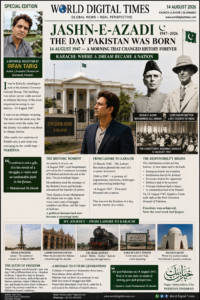
THE DAY PAKISTAN APPEARED ON THE WORLD MAP
14 August 1947 — A Morning in Karachi, a New Chapter in History
An Imagined Journey by Author Irfan Tariq Around Karachi’s Historic Governor General House
I was in Karachi.
Standing near the historic Governor General House, I found myself looking at an old building—but somehow, I was no longer standing in the present.
The walls were silent.
The gates were silent.
The trees seemed silent.
Yet I could hear something within that silence.
14 August 1947.
I closed my eyes.
And Karachi changed.
The traffic of today disappeared. The noise of the modern city faded away. In its place emerged a Karachi that was preparing to receive a new nation.
And at the heart of that historic morning stood one man:
Muhammad Ali Jinnah.
A Morning Unlike Any Other
The sun rising over Karachi that morning was the same sun that had risen countless times before.
The Arabian Sea was the same.
The city was the same.
But history was no longer the same.
Nearly two centuries of British rule in the subcontinent were coming to an end, while two new dominions were emerging.
For Pakistan, however, that morning was not the beginning of the story.
It was the culmination of a long and difficult journey.
Behind that morning stood Lahore, 23 March 1940.
There was the historic Muslim League session, the Lahore Resolution, Jinnah’s leadership, elections, negotiations, constitutional struggle, the Cabinet Mission, the 3 June Plan—and above all, the political determination of millions of Muslims who wanted a separate homeland.
A dream that had once been expressed as a political demand was about to become a state.
Governor General House — Where History Once Lived
I walked slowly around the historic Governor General House.
I looked at its walls and wondered:
How many historic conversations had these walls witnessed?
How many decisions?
How many anxious nights?
How many moments when the people inside probably did not realize that they were standing at the centre of history?
I imagined the evening of 13 August 1947.
Lord Mountbatten had arrived in Karachi.
The following morning he would stand before the Constituent Assembly as British India’s last Viceroy.
Across from him would stand the man who had led the political struggle for Pakistan.
The old order was preparing to leave.
A new order was preparing to begin.
14 August — Karachi Awakens
In my imagination, I walked from the Governor General House towards the historic assembly building.
The city was alive with anticipation.
People knew that this was not an ordinary day.
The atmosphere carried celebration—but also uncertainty.
Partition had already brought immense human suffering.
Millions were moving across newly created borders.
Some were leaving behind homes, businesses and ancestral lands.
Some were searching for relatives.
Some had lost everything except the hope of reaching Pakistan.
The new country was being born amid both joy and tragedy.
And Karachi stood at the centre of it all.
The Historic Assembly
I imagined myself standing outside the historic assembly hall.
Inside were the representatives of a state that had not existed only a few days earlier.
Then came the moment.
According to the official record, Lord Mountbatten took his seat at the dais at 9:10 a.m. on 14 August 1947.
I looked at my watch.
For a moment, I imagined that I had travelled through time.
9:10 a.m.
A simple time on a clock.
But behind those numbers was the end of one political era and the beginning of another.
Mountbatten addressed the gathering.
Then came the response from Jinnah.
And as I imagined him rising, I could almost see the previous seven years passing before my eyes.
From Lahore to Karachi
I saw 23 March 1940 again.
Lahore.
The Muslim League.
The historic resolution.
The crowds.
The flags.
The voice of Jinnah.
Then the years of struggle.
And finally—
1947.
Seven years had passed.
The road had been difficult.
There had been disagreements, negotiations, political battles and moments when the future itself seemed uncertain.
Yet the destination had finally appeared.
Pakistan.
Not a Gift, but the Result of a Political Struggle
Standing there in my imagination, I reminded myself of an important historical truth.
It would be too simplistic to say that Britain simply “gave” Pakistan to Jinnah on 14 August.
Pakistan was not created through a military conquest of the British or of Hindus.
It emerged through a prolonged political, constitutional, electoral and diplomatic struggle, led by Muhammad Ali Jinnah and the All-India Muslim League, backed by a powerful popular mandate.
The transfer of power was the formal conclusion of that political process.
The achievement was therefore not merely the arrival of independence.
It was the transformation of a political demand into a sovereign state.
The Flag
And then, in my imagination, I saw the green and white flag.
The crescent.
The star.
For millions, it represented a new beginning.
For the migrants arriving from different parts of India, it represented hope.
For families who had lost their homes, it represented a future.
For those who had sacrificed, it represented the fulfillment of a dream.
And for Jinnah?
I imagine he knew that the greatest challenge had only just begun.
Because obtaining a country and building a country were two very different things.
The Day After Freedom
The celebrations could not last forever.
A government had to function.
Millions of refugees had to be settled.
Institutions had to be established.
The economy had to be organized.
Defence had to be secured.
Foreign relations had to begin.
And a constitution had to be created.
On 15 August 1947, Jinnah took the oath as the first Governor-General of Pakistan.
The man who had fought to create Pakistan now had to govern it.
The dream had become a responsibility.
I Opened My Eyes
Suddenly, I was back in present-day Karachi.
The traffic had returned.
The sounds of the city had returned.
The historic building was still standing.
But something inside me had changed.
I looked once more towards the Governor General House.
I thought about the man who had walked through those historic surroundings.
I thought about the people who had waited for freedom.
And I thought about the generations that came after them.
My Journey to the Next Generation
If my future generations ever read these pages, I would want them to do more than memorize dates.
I would want them to visit Karachi.
Stand near its historic buildings.
Visit the old assembly site.
Stand before the Mazar-e-Quaid.
Then travel to Lahore.
Stand beneath the Minar-e-Pakistan.
And remember:
23 March 1940 was the dream.
14 August 1947 was the birth of the state.
But the story did not end there.
It became our responsibility.
The Final Scene
The evening falls over Karachi.
The sea breeze moves through the city.
The historic Governor General House stands quietly behind its gates.
Somewhere in the distance, the white dome of Mazar-e-Quaid rises above the city.
And in my imagination, I see Lahore once again.
The Minar of Pakistan.
The gathering of 1940.
Jinnah standing before the Muslim League.
Then seven years passing like pages of a book.
And finally—
Karachi, 14 August 1947.
A new flag.
A new state.
A new beginning.
I quietly say to myself:
“Quaid-e-Azam, the dream you gave a voice to in Lahore became a state in Karachi. You won Pakistan—but the responsibility of making Pakistan successful was left to us.”
And perhaps history is still standing there, silently waiting for our answer.
**Pakistan appeared on the world map on 14 August 1947.
But the real journey of Pakistan began that very day.**
Written & Researched by Irfan Tariq
An imagined historical reflection during a journey through Karachi
