
Khalilur Rahman Takes Helm of UN General Assembly
Bangladesh’s Khalilur Rahman Takes Helm of UN General Assembly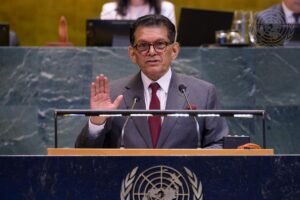 at a Defining Moment for the World
By Irfan Tariq
NEW YORK: Bangladesh’s Dr. Khalilur Rahman has assumed the presidency of the 81st session of the United Nations General Assembly, taking the gavel at a moment when the international system is facing an extraordinary convergence of wars, humanitarian crises, geopolitical rivalries, climate emergencies and technological disruption.
Rahman formally assumed the presidency on September 8, 2026, succeeding Germany’s Annalena Baerbock. His presidency comes with an ambitious theme: “Restoring Trust, Managing Transformation.” The message is particularly significant for an international system struggling with a widening gap between the principles of the UN Charter and the realities of contemporary geopolitics.
The UN General Assembly remains the world’s largest multilateral political forum, bringing together all 193 UN member states.
A World Under Pressure
Dr. Rahman takes charge at a time when the international community is confronting multiple crises simultaneously.
The wars and humanitarian emergencies in Gaza and the wider Middle East, the continuing Russia-Ukraine conflict, tensions among major powers, unresolved territorial disputes and growing military competition have placed enormous pressure on the multilateral system.
For the General Assembly, the challenge is not simply to pass resolutions. The greater question is whether diplomacy can still produce meaningful political outcomes when major powers themselves remain deeply divided.
Gaza and the Question of International Law
The Middle East will remain one of the most difficult issues before the UN.
The humanitarian situation in Gaza, protection of civilians, access to humanitarian assistance, reconstruction and the future of the Palestinian question will continue to test the credibility of the international community.
For the new General Assembly president, maintaining a space for dialogue while ensuring that humanitarian concerns and international law remain central will be a major diplomatic challenge.
Ukraine and the Search for Peace
The war in Ukraine represents another major test.
The international community remains divided over how to achieve a sustainable peace, guarantee security and reconcile the principles of territorial integrity and national sovereignty with competing security concerns.
The UN General Assembly has an important political role in keeping dialogue alive, even though binding decisions on international peace and security remain primarily within the Security Council’s mandate.
The AI Revolution
Perhaps the most transformative challenge of the 81st session will not come from a traditional battlefield but from artificial intelligence.
AI is rapidly changing warfare, employment, education, information systems, cybersecurity and economic competition.
The international community now faces difficult questions: Who should regulate advanced AI? How can misinformation and autonomous weapons be controlled? What safeguards are necessary when machines increasingly influence decisions affecting human lives?
For the UN, AI governance could become as important to the future international order as nuclear arms control was to the twentieth century.
Climate Change and Climate Justice
Climate change will also remain at the centre of the global agenda.
Extreme weather events, rising temperatures, floods, droughts, food insecurity and displacement are increasingly affecting developing countries that often have the least capacity to respond.
For countries across Asia, Africa and the Global South, the issue is increasingly framed not merely as environmental protection but as climate justice, financing and equitable development.
A UN Still Structured for 1945
Perhaps the most fundamental challenge facing Rahman is the question of whether the UN’s institutions adequately reflect the world of 2026.
The United Nations was established in 1945, following the Second World War. Since then, the global balance of economic, political and technological power has changed dramatically.
Yet the structure of the Security Council, particularly its permanent membership and veto system, remains one of the most contentious issues in international diplomacy.
Calls for greater representation of Asia, Africa and Latin America, along with wider reforms of the multilateral system, are likely to remain part of the debate.
Restoring Trust
Against this backdrop, Rahman’s theme of “Restoring Trust” carries particular weight.
Trust is arguably the most valuable—and most fragile—currency in international diplomacy.
When states believe that international rules are applied selectively, confidence in multilateral institutions declines. When resolutions repeatedly fail to produce political action, public faith in international organisations also suffers.
The new General Assembly president therefore faces a difficult task: to make the UN a place where differences can be negotiated rather than merely declared.
The Global South Watching Closely
Rahman’s leadership will also be closely watched by developing countries.
For much of the Global South, the central questions are straightforward: Can the UN deliver greater fairness in international decision-making? Can developing countries secure meaningful climate finance and development assistance? Can international law be applied consistently? And can the UN become more representative of today’s world?
These questions go beyond Bangladesh. They reflect a broader demand for a more balanced international order.
A Presidency That Matters
Dr. Khalilur Rahman begins his tenure at a historic crossroads.
The world is facing wars without easy solutions, climate emergencies without sufficient financing, technological change without adequate global rules, and geopolitical competition that is testing the foundations of multilateralism.
His greatest challenge will therefore not be managing the UN’s agenda but building bridges between increasingly divided nations.
The success of the 81st General Assembly may ultimately be measured not by the number of resolutions adopted, but by whether countries can rediscover the value of dialogue, compromise and collective action.
In a world increasingly defined by distrust, the new UN General Assembly president has chosen a theme that may be more necessary than ever: restore trust—and manage transformation before transformation begins to manage the world.
Written by Irfan Tariq
