
From Container City to the Negotiating Table
From Container City to the Negotiating Table
ko
PTI’s October 4 Protest, the Islamabad Lockdown, the KP-Federal Standoff and a New Political Opening
By Irfan Tariq
Islamabad is once again at the centre of Pakistan’s political storm. Containers line important roads, security arrangements have been tightened, the Pakistan Tehreek-e-Insaf (PTI) is preparing for an October 4 protest march, and the federal government and the Khyber Pakhtunkhwa government remain locked in an increasingly tense political confrontation.
Yet, amid the barricades and political rhetoric, another picture is emerging: the negotiating table.
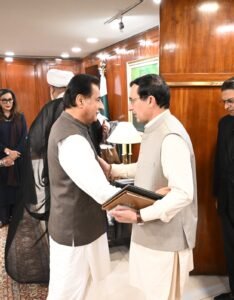
Prime Minister Shehbaz Sharif met President Asif Ali Zardari at Aiwan-e-Sadr shortly after returning from the United Nations General Assembly. The meeting reviewed the country’s political and security situation, with particular concern expressed over the situation in Khyber Pakhtunkhwa. The leadership also agreed that a joint delegation of the federal government and Pakistan Peoples Party Parliamentarians would engage the PTI in talks.
The development is significant because the government is simultaneously preparing for the possibility of the PTI march and exploring a political way out of the confrontation.
The question facing Pakistan is therefore no longer simply whether the October 4 protest will take place. It is whether the country can move from the politics of confrontation towards dialogue before another political crisis deepens the divide between Islamabad and Peshawar.
From Cricket Captain to Political Resistance
Imran Khan’s political journey has been one of the most consequential transformations in Pakistan’s recent history. The 1992 World Cup-winning cricket captain founded the Pakistan Tehreek-e-Insaf in 1996 and, after more than two decades of political struggle, became prime minister in 2018.
His government ended in April 2022 after he lost a vote of no confidence in the National Assembly. His subsequent political struggle increasingly moved from parliament to the streets, while his arrest, court cases and continued imprisonment became central issues in PTI’s political campaign.
For PTI, the release of its founder and what it describes as the restoration of constitutional supremacy remain major political demands. The party has therefore continued to rely heavily on public mobilisation and protest as instruments of political pressure.
A Pattern of Protest, Postponement and Confrontation
Since the present PML-N-led federal government came to power, PTI has repeatedly announced protests, rallies and marches, but the outcomes have varied.
In July 2024, a planned Islamabad rally was postponed after the authorities revoked permission. An August rally was also postponed and eventually held on September 8, when tensions developed between protesters and police after the permitted time expired.
In October 2024, PTI called off an Islamabad protest after receiving assurances regarding Imran Khan’s health and amid preparations for the SCO summit.
The November 2024 “final call” was different. PTI supporters moved towards Islamabad, while the government imposed extensive security measures and placed containers on major routes. The protest eventually ended after serious confrontation.
Subsequent PTI protest calls have also been postponed or altered for political and other reasons. This history shows that PTI’s protest strategy has neither produced one consistent outcome nor followed a single pattern. Some calls were postponed, some took place on a limited scale, and others developed into major confrontations.
The October 4 protest therefore comes with a political history behind it.
Islamabad: Security or Container City?
The government has a legitimate responsibility to protect Islamabad, government buildings, diplomatic missions, public property and citizens. Pakistan’s history of violent political confrontations makes security planning unavoidable.
But security and prolonged disruption of an entire capital are not necessarily the same thing.
Islamabad has increasingly acquired the appearance of a “container city” whenever a major political protest is announced. Major roads are blocked, traffic is diverted and ordinary citizens are forced to bear the consequences.
The financial cost is also substantial. Recent reports have put the daily rental cost of 1,550 containers at around Rs46.5 million, while broader security preparations could push the total expenditure into the hundreds of millions of rupees and potentially beyond one billion rupees.
The cost is not merely financial. Businesses lose working hours, patients face difficulties reaching hospitals, students and employees struggle with transportation, and diplomatic and commercial movement is disrupted.
The question is therefore not whether Islamabad should be protected. It is whether the same security objectives can be achieved through more targeted and less disruptive measures.
The Crisis Has Moved Beyond Islamabad
The most significant change in the present confrontation is that it is no longer simply a dispute between PTI and the federal government.
The political standoff now involves a PTI-led provincial government in Khyber Pakhtunkhwa confronting the federal government in Islamabad.
The federal authorities have raised concerns over law and order and security in the province, while PTI maintains that its provincial government has a constitutional and political mandate and that political disagreements should not become grounds for removing it.
The situation has brought the possibility of governor’s rule and emergency measures into political discussion. Government adviser Rana Sanaullah has said that the constitutional option remains available, while the government has also indicated that parliamentary and constitutional procedures would be required.
At the same time, PTI has warned against imposing governor’s rule or emergency measures, arguing that dialogue is the way to prevent confrontation.
The distinction is important: discussing a constitutional option is not the same as implementing it.
The Presidential Meeting: A Political Turning Point
Against this tense background, the meeting between President Asif Ali Zardari and Prime Minister Shehbaz Sharif assumes particular importance.
The meeting at Aiwan-e-Sadr came immediately after the prime minister’s return from the UN General Assembly and brought together senior figures from the federal government and PPP. The participants discussed the national political and security situation, including the deteriorating security environment in Khyber Pakhtunkhwa.
But the most significant outcome was the decision to open a direct political channel with PTI.
The government-PPP delegation included Interior Minister Mohsin Naqvi, Prime Minister’s Adviser on Political Affairs Rana Sanaullah and Amir Muqam from the federal government, while PPP representatives included Senator Sherry Rehman, Syed Naveed Qamar and Aijaz Jakhrani.
This was a significant shift in tone.
While preparations continued to contain the proposed march, the political leadership also chose to give dialogue another opportunity.
Negotiations Begin Under Sardar Ayaz Sadiq
That decision moved quickly from political consultation to an actual negotiating table.
On October 2, government and opposition representatives began talks at the chambers of National Assembly Speaker Sardar Ayaz Sadiq. The negotiations are taking place as the October 4 PTI march remains on the political calendar.
The government side includes Interior Minister Mohsin Naqvi, Adviser to the Prime Minister Rana Sanaullah, Minister of State for Interior Talal Chaudhry and representatives of the PPP, including Sherry Rehman. The opposition delegation includes PTI Chairman Barrister Gohar Ali Khan, Senate Opposition Leader Allama Raja Nasir Abbas and PTI leaders including Asad Qaiser, Salman Akram Raja, Amir Dogar and Haleem Adil Sheikh.
The opposition delegation was reconstituted after Mahmood Khan Achakzai declined to attend a meeting at the Speaker’s chamber, saying he preferred a neutral venue.
The talks therefore bring together representatives from both sides of the political divide at a moment when the country is facing the possibility of another confrontation.
That, in itself, is important.
Backdoor Contacts Become Open Dialogue
For several days, reports had suggested that informal contacts were taking place between the government and senior PTI figures. Rana Sanaullah also publicly acknowledged that “off-the-record” discussions were underway. (DAWN)
The latest development has now moved those contacts towards a formal political process.
PTI Chairman Barrister Gohar Ali Khan confirmed that his party had accepted the government’s invitation for talks. PTI has continued to maintain that its demands must be addressed, while the government has sought to prevent the October 4 march from developing into a confrontation.
The most striking image of the current crisis is therefore simple:
Containers are being placed on the roads while politicians are sitting around a table.
One represents resistance through physical barriers; the other represents the possibility of resolving political differences through conversation.
The Cost of Prolonged Confrontation
Pakistan is already dealing with inflation, pressure on household budgets and the economic consequences of higher petroleum costs.
In such circumstances, repeated political shutdowns carry a wider cost.
The government spends heavily on security, while traders, transporters, workers, students and ordinary citizens absorb the indirect economic consequences.
There is also an international dimension. Islamabad is Pakistan’s diplomatic capital, home to foreign embassies, international organisations and visiting diplomats. Repeated images of blocked roads, containers and prolonged security restrictions inevitably become part of the outside world’s picture of the country.
Security is essential. But stability is also essential, and political stability cannot be created permanently through barricades.
The Real Question Is Political
The October 4 confrontation is ultimately about more than a march.
It is about the relationship between the federal government and a province controlled by the opposition.
It is about the political future of PTI and its imprisoned founder.
It is about the government’s response to sustained opposition pressure.
It is about whether constitutional institutions can absorb political conflict without allowing it to become a confrontation between the federation and a province.
And it is about whether Pakistan’s political leadership can learn from the repeated cycle of protest, blockade, confrontation and negotiation.
The government has security responsibilities. PTI has the right to political expression and peaceful protest within the law. The provincial government has constitutional responsibilities. The federal government has constitutional responsibilities as well.
The challenge is to keep these responsibilities from colliding on the streets.
October 4 and the Road Ahead
The immediate question is what happens before October 4.
Will the negotiations produce enough common ground to prevent the march?
Will PTI modify or postpone its protest?
Will the federal government reduce restrictions if dialogue progresses?
Will the confrontation between Islamabad and Peshawar intensify?
And will the discussion of governor’s rule remain a political option, or move towards a formal constitutional process?
At present, the answers remain uncertain.
What is clear is that the meeting between President Zardari and Prime Minister Shehbaz Sharif has opened a political channel at a critical moment, and the subsequent negotiations under National Assembly Speaker Sardar Ayaz Sadiq have brought government and opposition representatives to the same table.
Pakistan has reached another crossroads.
The roads of Islamabad may be blocked by containers, but political differences cannot be permanently contained by steel.
A government can close a road for a day. A protest can bring a city to a standstill for a few hours. But neither can provide a lasting solution to a political conflict.
The lasting solution, if one is possible, must eventually come from the place where political differences are meant to be resolved: the negotiating table, the parliament and the Constitution.
