

AJK Elections 2026: PML-N Takes the Lead, but the Real Test Begins with Governance
AJK Elections 2026: PML-N Takes the Lead, but the Real Test Begins with Governance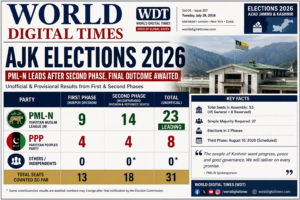
Analysis by Irfan Tariq
Muzaffarabad: The 2026 General Elections for the Azad Jammu and Kashmir (AJK) Legislative Assembly represent far more than a routine democratic exercise. They mark a defining moment in the region’s evolving political landscape, reflecting changing public expectations, growing political awareness, and an increasing demand for effective governance. Conducted in three phases, the elections have demonstrated that the people of AJK are no longer voting solely on the basis of traditional political loyalties; issues such as economic development, public service delivery, transparency, and political stability have become equally significant.
The first phase of polling, held across the Mirpur Division, gave the Pakistan Muslim League (N) a decisive advantage. The unofficial and provisional results from the second phase have largely reinforced that trend, with PML-N maintaining its lead while the Pakistan Peoples Party (PPP) secured victories in several key constituencies but remained behind overall.
Based on the unofficial results available so far from the first and second phases, PML-N has emerged as the largest political force with approximately 23 seats, while PPP has secured 8 seats. Since polling in a few constituencies has been postponed and official notifications are still pending, the final composition of the Assembly remains subject to change. Nevertheless, the current electoral trend clearly places PML-N in the strongest position to form the next government.
The election process was not without controversy. Reports of political tensions, isolated clashes, adverse weather conditions, landslides, and allegations of electoral irregularities surfaced in several constituencies. The Pakistan Peoples Party has called for investigations into alleged manipulation and administrative interference, while PML-N has rejected these accusations, describing the results as a reflection of public confidence in its leadership and development agenda. These competing narratives highlight that strengthening confidence in the electoral process remains an important challenge for AJK’s democratic institutions.
From a political perspective, PML-N’s electoral advantage is not merely a victory—it is also a significant responsibility. Should the party succeed in forming the government, it will face high public expectations regarding economic recovery, employment generation, infrastructure development, healthcare, education, tourism, and institutional reforms. Electoral success alone will not be sufficient; sustained performance will determine the government’s long-term political credibility.
For the Pakistan Peoples Party and other political stakeholders, the elections also carry an important lesson. The electorate of Azad Kashmir has become increasingly discerning, placing greater emphasis on governance, accountability, and practical solutions rather than relying exclusively on historical political affiliations. This transformation reflects the gradual maturation of democratic politics in the region.
Beyond domestic politics, the elections carry broader strategic significance. As a region closely linked to the internationally recognized Kashmir dispute, political stability and democratic legitimacy in Azad Jammu and Kashmir strengthen the region’s ability to articulate the aspirations of its people at both the national and international levels. A stable government with a credible public mandate is better positioned to address local governance challenges while contributing to Pakistan’s broader diplomatic narrative on Kashmir.
Attention now turns to the remaining phase of polling, the allocation of reserved seats, and the final official results. These developments will determine whether PML-N secures a clear parliamentary majority or whether coalition-building and support from independent members become necessary for government formation.
The central message emerging from the 2026 AJK elections is unmistakable: the politics of Azad Kashmir is entering a new era. The electorate has signaled that future political success will depend not on slogans or rhetoric, but on performance, transparency, economic progress, and responsive governance. The party that transforms electoral promises into measurable public outcomes will ultimately shape the next chapter of Azad Kashmir’s political future.
