

The Decisive Battle for Azad Kashmir: More Than an Election, A Test of Political Direction
The Decisive Battle for Azad Kashmir: More Than an Election, A Test of Political Direction
Muzaffarabad and Refugee Constituencies Hold the Key to Government Formation
By Irfan Tariq
Editor, World Digital Times
Democracy is not measured merely by the number of ballots cast; it is defined by the choices people make about their future. In Azad Jammu and Kashmir (AJK), elections have always carried a significance that extends well beyond the boundaries of the region. They reflect public confidence in governance, shape political leadership, and influence the broader discourse surrounding Kashmir.
The second phase of the 2026 AJK Legislative Assembly elections is therefore not simply another electoral exercise. It represents a decisive political contest that will determine who governs the region over the next five years and whether the political momentum established in the first phase can be sustained or dramatically reversed.
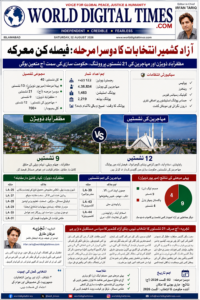
Following the first phase, where the Pakistan Muslim League-Nawaz (PML-N) secured a commanding lead in Mirpur Division, the political spotlight has now shifted to 21 crucial constituencies—nine in Muzaffarabad Division and twelve refugee constituencies spread across Pakistan. Collectively, these constituencies represent the final and perhaps most influential chapter of the electoral process.
The Numbers That Matter
More than 1.2 million registered voters are eligible to cast their ballots in this phase, choosing from over 340 candidates contesting 21 assembly seats. Among them are approximately 438,834 registered refugee voters, whose constituencies have historically played a pivotal role in determining the balance of power in the Legislative Assembly.
Unlike conventional elections, the refugee constituencies are geographically dispersed across Pakistan, with polling taking place in Islamabad, Rawalpindi, Lahore, Gujranwala, Faisalabad, Karachi, Peshawar, and other major cities. Their votes frequently determine whether a party achieves a governing majority or is compelled to negotiate coalition arrangements.
Muzaffarabad: The Political Heart of Azad Kashmir
If Mirpur is considered the commercial gateway of AJK, Muzaffarabad remains its political heart.
The electoral dynamics here differ significantly from other regions. Party affiliation is important, but personal credibility, family influence, development performance, and local leadership often carry equal—if not greater—weight.
Several constituencies are expected to witness exceptionally close contests.
LA-26 Muzaffarabad City is widely regarded as one of the most competitive urban seats, where government employees, professionals, traders, and young voters could decisively influence the outcome.
LA-27 Muzaffarabad remains a constituency shaped by influential political families and traditional electoral networks, making predictions particularly difficult.
In LA-28 Hattian Bala, issues such as post-earthquake reconstruction, infrastructure development, education, and healthcare continue to dominate political debate.
Meanwhile, Leepa Valley and Neelum Valley present a different electoral landscape, where border security, tourism, employment opportunities, and regional connectivity remain central concerns for voters.
Political analysts agree that success in Muzaffarabad Division is essential for any party aspiring to form a stable government.
Refugee Constituencies: The Traditional Kingmakers
The twelve refugee constituencies have long occupied a unique position in AJK politics.
While geographically located across Pakistan, these constituencies are constitutionally represented in the Azad Kashmir Legislative Assembly. Their electoral behaviour has often determined the formation—and in some cases the survival—of successive governments.
Among the most closely watched contests are:
- LA-39 Jammu & Others-VI (Rawalpindi–Islamabad)
- LA-43 Kashmir Valley-IV (Rawalpindi)
- LA-44 Kashmir Valley-V (Islamabad–Rawalpindi)
These constituencies are expected to witness intense competition between PML-N and the Pakistan Peoples Party (PPP), while several independent candidates may influence outcomes by attracting decisive vote shares.
A Different Political Climate
Compared with the 2021 elections, the political environment has changed considerably.
PML-N enters the second phase with renewed confidence after its strong performance in Mirpur Division. PPP, meanwhile, views Muzaffarabad and the refugee constituencies as its best opportunity to alter the electoral arithmetic.
This election is also taking place amid increased public expectations regarding governance, economic development, institutional performance, and political stability. Consequently, many voters appear to be evaluating candidates not only through partisan loyalty but also through their record of public service and credibility.
Beyond Numbers
Although elections are ultimately decided by numerical outcomes, politics is rarely governed by mathematics alone.
In Muzaffarabad Division, local identity, tribal affiliations, and candidate reputation remain powerful influences. In the refugee constituencies, however, national political trends and broader policy narratives often play a more prominent role.
This combination makes the second phase considerably more unpredictable than the first.
Even a narrow victory in a handful of constituencies could alter the composition of the next Legislative Assembly and redefine the balance between government and opposition.
Security and Democratic Responsibility
Following isolated incidents during the first phase, election authorities have strengthened security arrangements.
Police, Rangers, and rapid response units have been deployed at sensitive polling stations, while election officials have reiterated their commitment to ensuring a peaceful, transparent, and credible electoral process.
Ultimately, however, the credibility of any election depends not only on administrative preparedness but also on political maturity, public participation, and respect for democratic outcomes.
Conclusion
The second phase of the 2026 Azad Kashmir elections is far more than a contest for twenty-one assembly seats.
It is a political test of leadership, public confidence, institutional credibility, and democratic resilience.
Whether the Pakistan Muslim League-Nawaz succeeds in transforming its early momentum into a governing majority, or the Pakistan Peoples Party reshapes the political equation through gains in Muzaffarabad and the refugee constituencies, the results will influence the future trajectory of Azad Kashmir for years to come.
When the ballot boxes are opened, the outcome will reveal more than electoral winners and losers. It will reflect the aspirations of a people seeking effective governance, political stability, and accountable leadership in one of South Asia’s most politically significant regions.
The verdict of the voters today will not merely determine who governs Azad Kashmir tomorrow—it will help define the political direction of the region for the next five years.
— Irfan Tariq
Editor
World Digital Times
