
The Race for the Next UN Secretary-
The Race for the Next UN Secretary-General Enters a New Phase
Global Attention Turns to the UN Town Hall as Candidates Present Their Vision for the Future of the United Nations
By Irfan Tariq
As the United Nations prepares to choose its next Secretary-General, the selection process has entered one of its most important and transparent stages. On 23 July 2026, candidates seeking to become the world’s top diplomat will participate in a global Town Hall at the United Nations Headquarters in New York, where they will engage directly with representatives of civil society organizations and answer questions on the most pressing global challenges.
The event, organized by the President of the United Nations General Assembly, represents a significant step in the evolution of the Secretary-General selection process. Unlike previous decades, when discussions largely took place behind closed doors, today’s process places greater emphasis on transparency, accountability and public engagement.
A More Open Selection Process
The current selection process is being conducted under United Nations General Assembly Resolution 79/327, adopted in September 2025. The resolution strengthens transparency by requiring candidates to submit detailed vision statements, curriculum vitae and campaign financing disclosures while participating in public interactive dialogues.
The process officially began on 25 November 2025, when the Presidents of the General Assembly and the Security Council jointly invited UN Member States to nominate candidates.
Who Are the Candidates?
Seven candidates have been nominated during the process. Two later withdrew their candidacies, leaving five active contenders:
- Rafael Mariano Grossi (Argentina) – Director General of the International Atomic Energy Agency (IAEA), widely recognized for his work on nuclear diplomacy and international security.
- Rebeca Grynspan (Costa Rica) – Secretary-General of UN Trade and Development (UNCTAD) and former Vice President of Costa Rica, with extensive experience in sustainable development and international economics.
- María Fernanda Espinosa (Ecuador) – Former President of the UN General Assembly and former Foreign Minister of Ecuador, known for her multilateral diplomacy.
- Macky Sall (Senegal) – Former President of Senegal and former Chairperson of the African Union, bringing extensive political leadership experience.
- Carolyn Rodrigues Birkett (Guyana) – Former Foreign Minister of Guyana and experienced diplomat at the United Nations.
Among diplomatic observers, Grossi, Grynspan and Espinosa are generally regarded as the leading contenders, although no official favorite has emerged. Ultimately, the decision will depend on negotiations among the five permanent members of the UN Security Council.
Why the Town Hall Matters
The Town Hall offers a rare opportunity for global civil society to engage directly with candidates who aspire to lead the United Nations.
Participants are expected to question candidates on issues including:
- International peace and security
- Ongoing conflicts in Ukraine, Gaza and other regions
- Climate change
- Artificial intelligence and digital governance
- Human rights
- Sustainable Development Goals (SDGs)
- UN institutional reform
- Gender equality
- Global economic inequality
Unlike formal diplomatic meetings, the Town Hall allows candidates to explain not only their policies but also their leadership philosophy before a worldwide audience.
Pakistan’s Growing Diplomatic Role
Interestingly, Pakistan has become an important stop for several candidates during the campaign.
In recent days, Rebeca Grynspan, Macky Sall, and María Fernanda Espinosa held separate meetings with Prime Minister Muhammad Shehbaz Sharif in Islamabad. Earlier, Rafael Mariano Grossi had also visited Pakistan several times in his capacity as Director General of the IAEA, meeting the Prime Minister and senior Pakistani officials.
These engagements reflect Pakistan’s active participation in multilateral diplomacy and demonstrate the importance candidates attach to engaging with influential UN Member States.
How Is the Secretary-General Chosen?
Although the process is now more transparent than ever before, the decisive stage remains within the United Nations Security Council.
The Council first conducts informal consultations and a series of confidential “straw polls.” Any candidate opposed by one of the five permanent members—the United States, China, Russia, the United Kingdom or France—faces a significant obstacle because each permanent member has veto power.
Once the Security Council reaches consensus, it formally recommends one candidate to the United Nations General Assembly, which traditionally approves the recommendation by consensus.
The successful candidate will assume office on 1 January 2027 for a five-year term.
Challenges Await the Next Secretary-General
Whoever succeeds António Guterres will inherit one of the most demanding leadership positions in the world.
The next Secretary-General will confront:
- Intensifying geopolitical rivalry among major powers;
- Wars and humanitarian crises;
- Climate change and environmental degradation;
- Artificial intelligence governance;
- Global health preparedness;
- Reform of the UN system;
- Financing sustainable development;
- Restoring confidence in multilateral institutions.
The next UN leader will be expected not only to manage the Organization but also to rebuild trust in international cooperation at a time of increasing global polarization.
Looking Ahead
The 23 July Town Hall is more than a public debate—it is a defining moment in one of the world’s most consequential leadership contests. As candidates present their visions to global civil society, governments and international observers alike will be watching closely.
In the months ahead, diplomatic negotiations inside the Security Council will determine who emerges as the consensus candidate. The individual ultimately selected will assume responsibility for leading the United Nations through a period marked by conflict, technological transformation and unprecedented global challenges.
The choice made in 2026 will shape not only the future of the United Nations but also the direction of multilateral diplomacy for years to come.
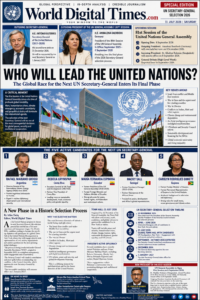
This can serve as a cover story for World Digital Times. It would pair well with a newspaper-style front page featuring the headline:
“WHO WILL LEAD THE UNITED NATIONS? – Inside the Global Race for the Next UN Secretary-General” with photos of all five active candidates, the UN Headquarters, and the 23 July Town Hall.
