

World Population Day: A Growing Planet, Changing Demographics, and the Challenge of the Future**
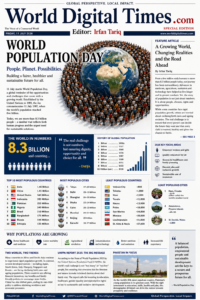 *World Population Day: A Growing Planet, Changing Demographics, and the Challenge of the Future**
**By Irfan Tariq**
Human civilization began with small communities scattered across the planet. For thousands of years, the world’s population grew slowly, but advances in agriculture, medicine, sanitation, and technology transformed the course of history. It took humanity thousands of years to reach its first one billion people, yet within just two centuries, the global population surged to unprecedented levels. Today, in 2026, the world’s population is estimated at approximately **8.3 billion**.
Every year on **July 11**, the international community observes **World Population Day**, established by the United Nations in 1989 following the symbolic milestone of **”Five Billion Day”** on July 11, 1987. The occasion is not merely about counting people; it serves as a global reminder of the importance of health, education, gender equality, family planning, youth empowerment, and sustainable development.
Today, **India** is the world’s most populous country, followed by **China**, the **United States**, **Indonesia**, and **Pakistan**. At the other end of the spectrum, **Vatican City** remains the world’s smallest sovereign state by population, with only a few hundred residents, while **Tuvalu, Nauru, Niue,** and **Tokelau** are among the least populated nations and territories.
The world’s largest urban area is **Tokyo**, home to nearly 40 million people. It is followed by major metropolitan centers such as **Delhi, Shanghai, Dhaka, Cairo, Mumbai, Beijing,** and **Karachi**, reflecting the rapid pace of global urbanization. In contrast, **Hum** in Croatia—often recognized as the world’s smallest town—has only a few dozen permanent residents. **Adamstown** in the Pitcairn Islands and **St. Davids** in Wales are also among the world’s least populated urban settlements.
Several factors have contributed to the dramatic rise in global population. Medical breakthroughs have significantly reduced mortality rates, vaccines and modern healthcare have controlled deadly diseases, agricultural innovation has increased food production, and improved sanitation and nutrition have extended life expectancy. Together, these developments have enabled humanity to live longer and in greater numbers than ever before.
However, rapid population growth also presents significant challenges. Increasing demand for food, clean water, housing, healthcare, education, employment, and energy is placing unprecedented pressure on natural resources. Climate change, environmental degradation, deforestation, pollution, and unplanned urban expansion have become defining global concerns.
Ironically, the world is now facing two contrasting demographic realities. While many countries in Africa and South Asia continue to experience rapid population growth, several developed nations—including **Japan, South Korea, Italy, Hungary, Singapore,** and **Russia**—are struggling with declining birth rates and ageing populations. These countries are introducing financial incentives and family-friendly policies to encourage higher birth rates. **China**, once known for its strict one-child policy, has also reversed course in response to demographic decline and labour shortages.
According to the latest **State of World Population** report by the **United Nations Population Fund (UNFPA)**, the global population debate is no longer simply about “too many” or “too few” people. Instead, the central issue is whether individuals have the freedom and opportunity to make informed choices about family size. The report emphasizes that sustainable population policies should be based on education, healthcare, gender equality, economic security, and the protection of reproductive rights—not coercion.
As the world’s fifth most populous country, **Pakistan** occupies a significant place in this global demographic landscape. Its large youth population has the potential to become a powerful engine of economic growth. However, this demographic advantage can only be realized through sustained investment in education, skills development, healthcare, and employment opportunities.
World Population Day ultimately reminds us that the true strength of a nation is measured not by the size of its population, but by the quality of its human capital. A healthy, educated, skilled, and empowered population is the foundation of sustainable development and lasting prosperity. In an era of profound demographic change, the challenge before humanity is not simply to manage population growth, but to ensure that every individual has the opportunity to contribute to a more equitable, resilient, and sustainable future.
This version follows the style commonly used by international newspapers, policy journals, and think tanks, while remaining readable for a global audience. It is publication-ready with only minor copyediting if needed.
