
America at 250: From a Declaration of Independence to a Global Legacy of Leadership,
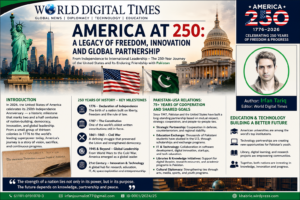
America at 250: From a Declaration of Independence to a Global Legacy of Leadership, Innovation, and Diplomacy
“A nation’s true strength is measured not only by the power of its military or the size of its economy, but by the endurance of its ideals and the impact it leaves on humanity.”
In 2026, the United States of America reaches a remarkable milestone—250 years since the adoption of the Declaration of Independence on July 4, 1776. This historic anniversary, known as the Semiquincentennial, commemorates the birth of a nation founded on the ideals of liberty, representative government, and the rule of law. Across the country, the United States Semiquincentennial Commission, commonly known as America250, is coordinating nationwide commemorative activities. President Donald Trump has publicly highlighted the significance of the anniversary, calling it an opportunity to celebrate the nation’s history, achievements, and future vision.
Two and a half centuries ago, thirteen British colonies made a bold decision that changed world history. Their declaration of independence was more than a rejection of colonial rule—it introduced a political philosophy that governments derive their authority from the consent of the governed. That principle influenced democratic movements across continents and became one of the defining ideas of the modern age.
America’s path, however, has never been simple. Independence was secured only after years of revolutionary struggle against the British Empire. The adoption of the Constitution in 1787 established one of the world’s oldest written constitutions still in force, creating institutions that have guided the country through periods of prosperity, crisis, reform, and transformation.
From thirteen original states, the United States gradually expanded into a nation of fifty states through diplomacy, territorial purchases, settlement, and, at times, armed conflict. The Louisiana Purchase, westward expansion, the admission of new states, and the preservation of the Union during the Civil War fundamentally reshaped the nation’s geography and identity.
The twentieth century transformed the United States into a global leader. Industrial growth, scientific discovery, and innovation accelerated economic development. Following its decisive role in the two World Wars and its leadership during the Cold War, America emerged as one of the principal architects of the modern international order.
Beyond military and economic influence, one of America’s greatest strengths has been its commitment to knowledge and innovation. The United States is home to many of the world’s leading universities, research institutions, and technology companies. Institutions such as Harvard University, Massachusetts Institute of Technology, Stanford University, and Carnegie Mellon University have educated generations of scientists, entrepreneurs, diplomats, and global leaders. American research has contributed to advances in medicine, artificial intelligence, aerospace, engineering, agriculture, and information technology that benefit people far beyond its borders.
The digital revolution further strengthened America’s global influence. Companies headquartered in the United States transformed communication, commerce, and innovation, making the country a driving force behind the modern information economy. Today, Silicon Valley remains one of the world’s foremost centers of technological development and entrepreneurship.
The relationship between the United States and Pakistan represents one of Washington’s longest diplomatic partnerships in South Asia. Since Pakistan’s independence in 1947, both countries have experienced periods of close cooperation, strategic partnership, policy disagreements, and renewed engagement. During the Cold War, Pakistan became an important regional partner. Cooperation deepened again during the Soviet-Afghan conflict and later after the events of September 11, 2001, when both countries worked together in counterterrorism efforts.
Yet the relationship extends well beyond security.
Educational cooperation has become one of the strongest pillars of Pakistan–United States relations. Thousands of Pakistani students have pursued higher education at American universities, while exchange initiatives have enabled scholars, teachers, researchers, and young professionals from both countries to learn from one another. These academic partnerships have strengthened scientific research, public policy, entrepreneurship, and people-to-people understanding.
American support has also contributed to educational development within Pakistan through English-language programs, teacher training, university partnerships, scholarships, and professional exchanges. These initiatives have helped build capacity in education, public administration, journalism, health sciences, and technology.
Technology cooperation has expanded significantly over the past two decades. Pakistan’s growing IT sector has benefited from collaboration with American technology companies, software firms, startups, and investment networks. Many Pakistani software engineers, entrepreneurs, and innovators now work with U.S.-based companies or establish successful businesses serving global markets. This digital partnership continues to create opportunities for employment, innovation, and economic growth.
Libraries and educational resource initiatives have also formed an important part of bilateral cooperation. Through various educational and cultural programs supported by the United States, universities, public institutions, and learning centers in Pakistan have received assistance in expanding access to books, digital resources, research materials, and information technology. Such initiatives reflect a broader belief that knowledge is one of the strongest foundations of lasting international partnership.
Cultural diplomacy has been equally significant. Art, literature, music, cinema, sports, and educational exchanges have helped connect people from different backgrounds, demonstrating that diplomacy is often strongest when built through mutual understanding rather than political agreements alone.
The Embassy of the United States, Islamabad, together with its consulates and educational partners, continues to promote cooperation in education, entrepreneurship, public health, cultural preservation, women’s empowerment, climate resilience, and youth leadership. These efforts illustrate that diplomacy is not limited to governments—it also flourishes through classrooms, research laboratories, libraries, businesses, and communities.
As America celebrates its 250th anniversary, the occasion is more than a remembrance of the past. It is an invitation to reflect on the principles that have shaped the nation and the responsibilities that accompany global leadership. From the battlefields of the Revolution to the laboratories of modern science, from constitutional debates to technological innovation, the American story is one of continual reinvention.
For Pakistan and the United States, the future of the relationship will likely depend less on moments of geopolitical urgency and more on sustained cooperation in education, trade, technology, scientific research, climate action, cultural exchange, and economic development. These are the areas where both nations can build enduring trust and shared prosperity.
At 250 years, America stands not merely as a nation commemorating its past, but as a country looking toward its future. Its greatest legacy may not simply be its economic power, military strength, or technological leadership, but its enduring belief that free societies grow stronger through knowledge, innovation, dialogue, and the shared pursuit of opportunity. Such ideals remain relevant not only to the American people, but to an increasingly interconnected world.
