
The New River of Global Politics: Trump–Xi Dialogue,
The New River of Global Politics: Trump–Xi Dialogue,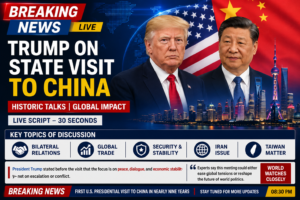 BRICS Realignments, Middle East Rebalancing, and Pakistan’s Emerging Role as a Peace Ambassdor
The world today stands at a historic inflection point, where the post–Cold War unipolar order is steadily dissolving and giving way to a more complex, uncertain, and multipolar global system. This transition is not sudden, but the result of a gradual redistribution of power shaped by economics, technology, geopolitics, and shifting diplomatic instincts across continents.
At the heart of this transformation lies the United States–China relationship. Once framed in simplistic terms of rivalry, it has now evolved into a managed competition—one in which both confrontation and interdependence coexist. Recent high-level engagements between Donald Trump and Xi Jinping have underscored this reality: neither side is seeking open rupture, yet neither is prepared to concede strategic space.
The increasing intensity of US–China competition has paradoxically produced a stabilizing effect in some areas. What appears as “pressure” has also triggered a cautious thaw, suggesting that neither Washington nor Beijing can afford uncontrolled escalation. The global economy, supply chains, technological ecosystems, and financial stability are too deeply interlinked for a clean break.
In this sense, the relationship is no longer about resolution but about management—a delicate calibration of rivalry designed to prevent systemic collapse.
Alongside this, BRICS has emerged as more than an economic grouping; it is increasingly functioning as a political and strategic platform representing a shifting global balance. At its recent engagement, Iran played a notably assertive role, projecting resistance to Western pressure while also acknowledging Pakistan’s regional relevance and diplomatic importance. This was widely interpreted as a symbolic recognition of Pakistan’s growing strategic visibility.
In South Asia, another significant development is unfolding. Within India itself, voices from former military and security circles are increasingly acknowledging that long-standing strategic approaches toward Pakistan have not delivered the desired outcomes. A growing debate now exists within sections of Indian strategic thinking suggesting that dialogue and diplomatic engagement may be unavoidable. This internal reassessment reflects a broader regional reality: the rigid frameworks of past decades are giving way to more pragmatic considerations.
Pakistan, in this evolving landscape, is gradually repositioning itself from a purely geopolitical stakeholder to a potential peace broker and connective actor. Multiple international observers, including Western policy circles, increasingly recognize Pakistan’s potential role in facilitating indirect communication and reducing regional tensions. This emerging identity is not based on rhetoric, but on geography, strategic relationships, and evolving diplomatic necessity.
Rather than acting as a traditional power center, Pakistan is increasingly viewed as a connective state—one that enables communication between competing blocs and supports crisis de-escalation through indirect diplomacy.
The Middle East is undergoing a parallel transformation. Countries such as Saudi Arabia, the United Arab Emirates, Qatar, Oman, Egypt, and Türkiye are increasingly pursuing “multi-alignment diplomacy,” seeking balanced relationships with multiple global powers instead of rigid bloc alignment. While the UAE’s orientation appears to lean more strongly toward India in economic and strategic terms, this remains part of a broader hedging strategy rather than a complete geopolitical shift.
Energy politics, particularly around Iran and the Strait of Hormuz, remains one of the most sensitive fault lines in the global system. Even minor disruptions in this corridor can have immediate consequences for global oil prices and economic stability. As a result, major powers continue to prioritize stability in the region despite their broader political disagreements.
In parallel, discussions around potential US–Iran engagement continue to circulate in diplomatic and policy circles, though no confirmed timeline or formal announcement has been made. This reflects a broader trend in which even adversarial relationships are increasingly managed through indirect channels rather than open confrontation.
Afghanistan remains a persistent security concern for the region, with non-state actors and governance vacuums continuing to pose risks not only to South Asia but also to broader Central Asian stability.
At the same time, Kashmir remains an unresolved and structurally sensitive issue in South Asia, shaping the strategic calculations of regional actors and maintaining a constant undercurrent of tension.
Against this backdrop, Pakistan’s diplomatic positioning becomes even more significant. Its strategic partnership with China, particularly through the China–Pakistan Economic Corridor (CPEC), anchors it firmly within China’s regional connectivity vision. At the same time, Pakistan maintains functional relationships with the United States and key Gulf states, enabling it to operate across multiple diplomatic spheres.
The upcoming visit of Pakistan’s Prime Minister to China is widely viewed as an important signal of continued strategic consolidation. Similarly, reports of a possible visit by Russian President Vladimir Putin to China reflect a broader pattern of intensified high-level engagement among major powers, suggesting a shift away from direct confrontation toward structured diplomatic interaction and parallel alignments.
All these developments point toward a fundamental reality: the world is neither moving toward outright war nor stable peace. Instead, it is entering an era of managed instability, where competition is constant but carefully contained.
Within this framework, Pakistan’s potential role as a facilitator of dialogue and a channel for indirect communication becomes increasingly relevant. It is not emerging as a traditional power broker, but as a stabilizing connector within a fragmented global order.
Conclusion
The contemporary international system is defined not by fixed hierarchies but by fluid power balances, overlapping dependencies, and continuous recalibration.
The United States and China remain systemic rivals, yet deeply interdependent actors. BRICS and other regional groupings are reshaping global narratives, while Middle Eastern states increasingly pursue strategic autonomy through multi-alignment diplomacy.
In South Asia, internal debates within India suggest a gradual recognition of the limits of confrontational approaches, opening space—at least conceptually—for renewed diplomatic engagement. Within this evolving environment, Pakistan is increasingly being viewed as a potential peace facilitator and diplomatic connector, rather than merely a regional stakeholder.
Ultimately, the defining challenge of this century is no longer how to dominate rivals, but how to manage rivalry without allowing it to destabilize the global system.
