
president zardari in berlin
Zardari in Berlin: A New Test for Pakistan’s Diplomacy
Economic Partnership with Germany, Diplomacy Between Washington and Tehran, Afghanistan and the Makkah Defence Pact: Multiple Messages from One Visit
Written by Irfan Tariq
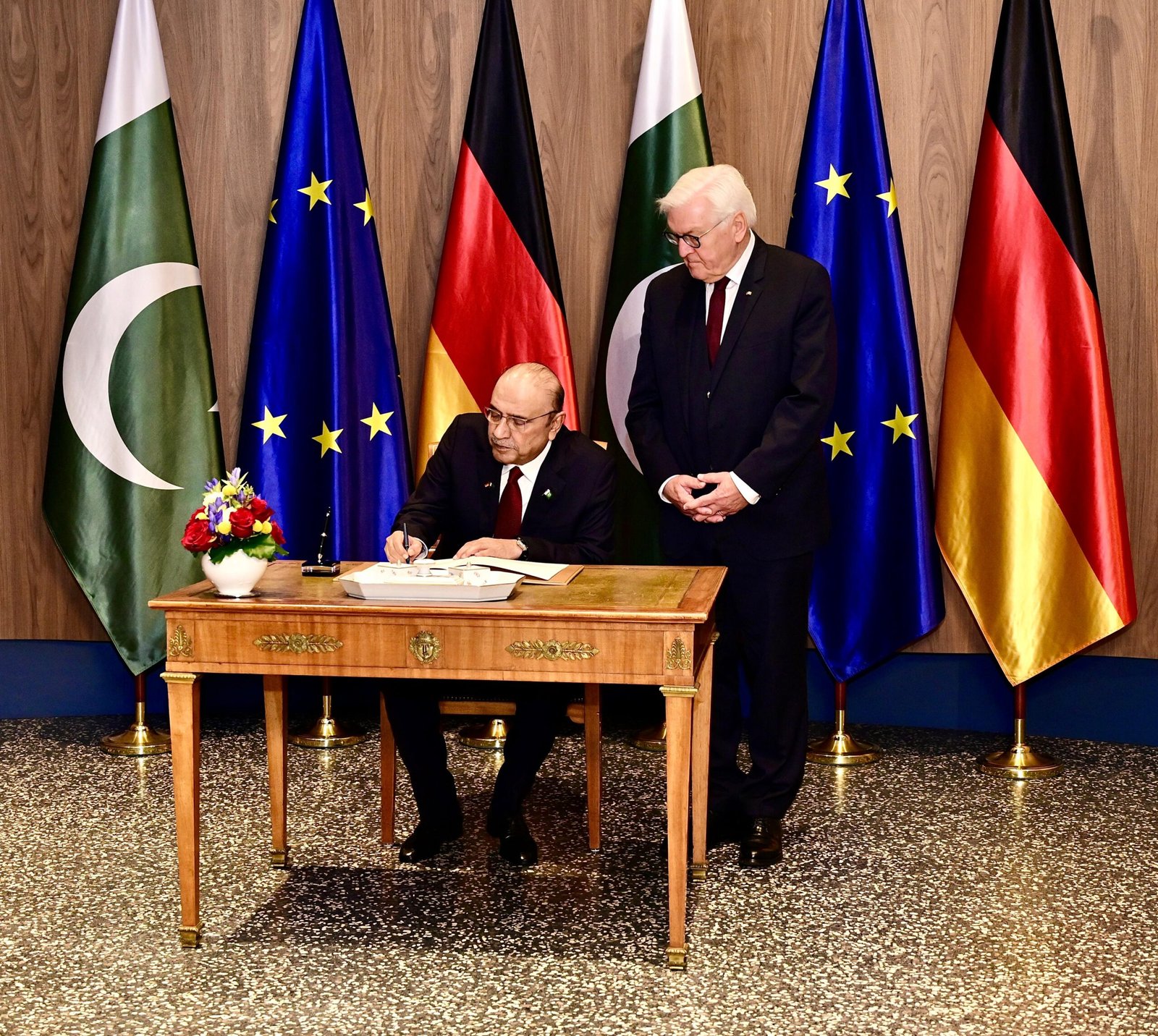
President Asif Ali Zardari’s visit to Germany is more than a routine diplomatic engagement. It comes at a time when Pakistan is attempting to advance economic cooperation, regional security and a diplomatic role in resolving conflicts—all at once. During his meeting in Berlin with German Federal President Frank-Walter Steinmeier, discussions extended beyond traditional bilateral issues to include Pakistan’s mediation efforts in the US-Iran conflict, the situation in Afghanistan and the Makkah Defence Pact. These subjects have placed the visit within a broader strategic context.
The significance of the visit is further underlined by the fact that Pakistan and Germany are marking the 75th anniversary of the establishment of diplomatic relations in 2026, while it is the first visit by a Pakistani president to Germany in 23 years. The central question, however, is not simply how long the two countries have been friends, but whether this historic occasion can be transformed into a new and effective partnership.
Germany: An Important Economic Gateway to Europe
Germany’s importance to Pakistan extends well beyond its political standing in Europe. It is Pakistan’s most important trading partner within the European Union. According to the German Foreign Office, bilateral trade between the two countries reached €3.3 billion in 2024. Nevertheless, there remains considerable room to expand trade, investment, technology and industrial cooperation.
The emphasis placed during the Zardari-Steinmeier meeting on trade, investment, emerging technologies, education, vocational training, healthcare, agriculture, industry and climate resilience reflects this need. If Pakistan wants to give its relationship with Germany a new direction, it must move beyond diplomatic statements and focus on creating a reliable environment for investors, maintaining policy continuity, developing a skilled workforce and strengthening business links.
Germany’s industrial expertise and Pakistan’s young workforce could create opportunities for both countries. Vocational education, professional training, renewable energy, industrial modernisation and digital technology are among the fields where cooperation could produce tangible results in employment, productivity and exports.
Investment, however, does not follow merely from friendly relations or joint declarations. Investors look for political and economic stability, transparent regulations, enforceable contracts and predictable returns. Turning the priorities discussed in Berlin into practical outcomes will therefore require sustained engagement among governments, businesses, universities and relevant experts.
A 23-Year Gap and a New Direction in Diplomacy
The fact that a Pakistani president has visited Germany after 23 years is a significant diplomatic development. Yet the long interval also raises a question: why were high-level relations with one of Europe’s largest economies not maintained more regularly?
German President Steinmeier’s warm welcome for Zardari and his interest in expanding bilateral business, education and technical cooperation suggest that both countries are willing to move their relationship forward. The German president also acknowledged Pakistan’s growing diplomatic role in resolving regional and international disputes.
For Pakistan, this is an opportunity to translate diplomatic goodwill into economic engagement. Stronger ties with a country such as Germany could improve access to European markets, promote industrial partnerships and research cooperation, and create organised opportunities for skilled Pakistanis.
Progress, however, will depend on whether the two countries can turn their shared goals into measurable initiatives, regular consultations and long-term planning.
The US-Iran Conflict: A Diplomatic Opportunity for Pakistan
One important aspect of the meeting was the discussion of Pakistan’s mediation role in the conflict between the United States and Iran. President Zardari thanked the German president for recognising Pakistan’s efforts and emphasised the importance of sustained dialogue and constructive negotiations.
This issue matters to Pakistan because its geography, border with Iran, economic links with the Gulf and relationship with the United States expose it directly to the consequences of regional tensions. Supporting negotiations is therefore not only a diplomatic position; it is also consistent with Pakistan’s own national interests.
Yet mediation cannot be sustained by diplomatic praise alone. It requires the trust of the parties involved, continuous communication, a credible approach and negotiating channels capable of reducing tensions in practical terms.
Germany’s recognition of Pakistan’s diplomatic role creates an opportunity for Islamabad and Berlin to cooperate more closely on regional peace, conflict prevention and international diplomacy. That possibility will become meaningful only if both countries translate shared interests into sustained diplomatic engagement and concrete initiatives.
Afghanistan: Balancing Humanitarian Responsibilities and National Security
Afghanistan was another prominent subject at the meeting. The German president appreciated Pakistan’s assistance in verifying 500 Afghan nationals destined for repatriation to Germany. He also commended Pakistan for providing humanitarian assistance to millions of Afghans over more than four decades.
This acknowledgement highlights the long-standing responsibility Pakistan has shouldered in hosting people displaced by conflict in Afghanistan. But Pakistan’s current Afghanistan policy has another dimension: its security concerns and the threat of cross-border terrorism.
President Zardari made clear that Pakistan has no conflict with the Afghan people. However, he said Pakistan would not allow Afghan territory to be used to attack Pakistani citizens or violate Pakistan’s sovereignty.
These are two distinct but interconnected imperatives: maintaining humanitarian concern and respect for the rights of the Afghan people, while protecting the lives, property and national security of Pakistan’s citizens. A sustainable solution will require continued engagement among the Afghan authorities, Pakistan and relevant international actors on counterterrorism, border management and humanitarian issues.
European partners such as Germany could play a constructive role through support for humanitarian assistance, refugee protection and diplomatic engagement. Effective cooperation, however, requires security concerns and human rights obligations to be addressed in a balanced manner rather than treated as mutually exclusive priorities.
The Makkah Defence Pact: A Message About Regional Security
The Makkah Defence Pact was another important and potentially sensitive subject. Responding to the German president’s interest, President Zardari said the pact was intended to ensure regional security and was not directed against any particular country.
The statement matters because countries interpret new defence arrangements through their own security perceptions and strategic concerns. Pakistan therefore has an interest in keeping the objectives, scope and purpose of its defence cooperation clear, while emphasising that an effective regional security framework should help reduce tensions, build confidence and encourage peaceful resolution of disputes.
Defence cooperation and diplomacy are not necessarily contradictory. Maintaining a balance between the two, however, is essential. The success of any regional arrangement should be measured not only by the defence capabilities it creates, but also by its contribution to preventing crises, reducing misunderstandings and strengthening opportunities for dialogue.
If Pakistan presents the pact as part of a broader commitment to regional stability, it will also need to maintain transparent diplomatic engagement and consistently support peaceful coexistence.
Relations with Germany: Beyond Traditional Foreign Policy
Another important message from Zardari’s visit is that Pakistan’s relationship with Europe’s major economies should not be confined to political support or ceremonial diplomacy. In the modern economy, trade, technology, research, education, skills development and climate cooperation have become central components of foreign policy.
There are several practical ways to transform existing trade and development links between Pakistan and Germany into a broader partnership. Direct engagement between German industrial companies and Pakistani businesses, vocational training programmes, joint research projects, cooperation in energy and improved access for Pakistani products to European markets could all contribute to this process.
Strengthening educational and cultural ties is equally important. Stronger people-to-people connections provide a more durable social foundation for diplomatic relations.
President Zardari invited the German president to visit Pakistan. Steinmeier responded that he would consider visiting at an appropriate time. This exchange suggests the possibility of continued high-level engagement. Its real value, however, will depend on whether the relevant ministries, businesses and private-sector institutions follow up with concrete projects.
The Real Test of Berlin
The 75-year history of diplomatic relations between Pakistan and Germany is an important milestone. But history gains greater significance when it helps shape future achievements. Zardari’s visit offers an opportunity for both countries to move beyond traditional friendship and develop a partnership that delivers visible results in trade, investment, education, technology and regional peace.
Pakistan’s challenge is to connect its diplomatic activity with economic outcomes and lasting international confidence. Germany has an opportunity to develop its relationship with Pakistan into a more effective bridge for economic, technical and diplomatic cooperation between Europe and South Asia.
The Berlin meeting has opened a door of opportunity. The real significance will lie in the decisions, projects and sustained engagement that follow. Successful diplomacy is not simply about increasing the number of meetings; it is about reducing differences, strengthening economies and expanding the prospects for peace.
Irfan Tariq
