


Pakistan Budget 2026-27:
🇵🇰 Pakistan Budget 2026-27: A Nation Balancing Debt, Defence and Development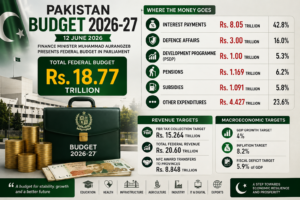
On the evening of 12 June 2026, Pakistan’s Parliament turned into the centre of national attention as Finance Minister Muhammad Aurangzeb presented the federal budget for FY 2026-27. The moment carried weight far beyond political formality. It reflected the country’s ongoing struggle between economic survival, fiscal discipline, and public expectations.
The federal budget was announced at Rs 18.77 trillion, revealing a financial structure heavily dominated by debt servicing and rigid expenditure commitments. According to the breakdown, Rs 8.05 trillion has been allocated only for interest payments on domestic and external debt, making it the single largest component of the budget. This means a significant share of national resources is already consumed before development spending begins.
Defence spending was set at Rs 3.0 trillion, marking an increase of nearly 18% compared to the previous year. The government justified this rise on the basis of regional security dynamics and the need to maintain operational readiness in a volatile geopolitical environment. While strategically important, this increase further tightens the fiscal space available for social and economic sectors.
For development purposes, the Public Sector Development Programme (PSDP) was allocated Rs 1.0 trillion, a figure that highlights the continuing pressure on infrastructure investment. Economists note that this level of development spending remains insufficient for a country with rapid population growth, urban expansion, and infrastructure gaps in energy, transport, and water systems.
Pension expenditures have reached Rs 1.169 trillion, while subsidies stand at Rs 1.091 trillion, reflecting the government’s attempt to cushion vulnerable groups amid persistent inflationary pressures. However, these commitments also contribute to rising rigid expenditures, leaving limited fiscal flexibility.
On the revenue side, the Federal Board of Revenue has been assigned an ambitious target of Rs 15.264 trillion, a significant increase compared to the previous year. Total federal revenue is projected at Rs 20.6 trillion, with provinces expected to receive Rs 8.848 trillion under the NFC Award distribution. This structure shows Pakistan’s growing reliance on aggressive tax collection and improved documentation of the informal economy.
Macroeconomic targets set for the year include 4% GDP growth and 8.2% inflation, signaling an attempt to balance growth with price stability. However, analysts point out that achieving these targets will depend heavily on external financing conditions, energy price stability, and successful implementation of tax reforms.
As the budget speech concluded, political reactions split sharply. The government described it as a “stability-oriented and reform-driven budget” designed to maintain fiscal discipline and meet international obligations. The opposition, however, criticized it for offering limited immediate relief to citizens already burdened by high living costs.
The broader economic picture remains complex. With nearly half of total expenditures consumed by debt servicing and a significant portion locked in defence and pensions, Pakistan’s fiscal space for growth-oriented spending remains constrained. Development experts argue that without structural reforms in taxation, energy efficiency, and industrial productivity, the economy will continue to operate under pressure.
For ordinary citizens, the impact remains mixed. Salaried individuals are expected to face continued tax pressure, businesses are watching for policy consistency, and the agriculture sector awaits practical implementation of announced support measures. Meanwhile, the youth population continues to look toward job creation and private sector expansion as the key to long-term stability.
Ultimately, the Budget 2026-27 is not a document of transformation, but of adjustment. It reflects an economy attempting to stabilize itself within tight constraints, where every rupee is already spoken for before it is spent.
The real question now is not what was announced in Parliament, but whether these numbers can translate into real change in markets, factories, farms, and households across Pakistan.
