

Pakistan, China Deepen Strategic Alignment; Launch Joint Initiative for Middle East Peace
Pakistan, China Deepen Strategic Alignment; Launch Joint Initiative for Middle East Peace
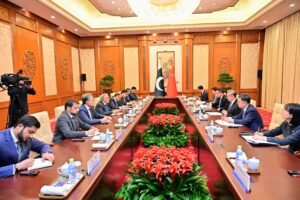
Beijing: Pakistan and China have reaffirmed their strong strategic partnership and stepped up diplomatic coordination on regional peace, as Deputy Prime Minister/Foreign Minister Ishaq Dar met Chinese Foreign Minister Wang Yi in Beijing on March 31.
The high-level meeting, marked by traditional warmth and cordiality, focused on evolving regional dynamics in West Asia, bilateral cooperation, and broader security concerns. Both sides expressed deep concern over the escalating situation in the Middle East and its socio-economic impact on developing countries, agreeing that urgent, coordinated efforts are needed to restore stability.
In a significant development, Pakistan and China jointly launched a five-point initiative aimed at promoting peace and stability in the Gulf and Middle East, signaling a more proactive diplomatic role by both countries in global conflict resolution.
Ishaq Dar briefed Wang Yi on Pakistan’s ongoing diplomatic engagements, including a recent meeting in Islamabad involving foreign ministers of Saudi Arabia, Türkiye, and Egypt, aimed at de-escalation and dialogue. China appreciated Pakistan’s active role, with Wang Yi reaffirming Beijing’s support for Islamabad’s peace efforts.
On bilateral ties, both countries reviewed progress with satisfaction and reiterated their commitment to advancing CPEC 2.0, focusing on high-quality development, strategic connectivity, and economic cooperation. The leaders also highlighted the symbolic importance of 2026, marking 75 years of Pakistan-China diplomatic relations, and agreed to enhance high-level exchanges throughout the year.
Discussions also covered Afghanistan, where both sides stressed the importance of peace, stability, and coordinated counterterrorism efforts to prevent regional spillover.
Analysis
The meeting underscores Pakistan’s attempt to position itself as a key diplomatic bridge in the Muslim world, particularly in the Middle East, while leveraging China’s global influence to amplify its role. The joint five-point initiative reflects a shift from passive alignment to active agenda-setting in regional diplomacy.
For China, this engagement aligns with its broader objective of expanding influence in West Asia, especially amid ongoing geopolitical tensions. Supporting Pakistan not only strengthens Beijing’s regional partnerships but also complements its Belt and Road ambitions under CPEC 2.0.
The renewed focus on economic cooperation suggests both countries are looking to stabilize their domestic economies through deeper integration, even as external uncertainties persist. Meanwhile, the inclusion of Afghanistan in discussions highlights shared security concerns and the need for coordinated regional strategies.
Overall, the visit signals a convergence of strategic, economic, and diplomatic priorities, reinforcing the long-standing Pakistan-China partnership while expanding its scope into emerging global challenges.
