
Pakistan’s Quiet “Peace Mission” — Signals of Diplomatic Momentum Between Tehran, Washington, and the Middle East
Pakistan’s Quiet “Peace Mission” — Signals of Diplomatic Momentum Between Tehran, Washington, and the Middle East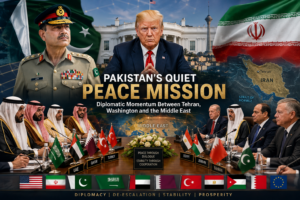
Field Marshal Asim Munir’s second key visit to Iran, Trump’s emergency diplomacy, softening US–Iran proposals, and renewed hopes for de-escalation in the region
By Irfan Tariq — Journalist and Author, Islamabad
Islamabad / Tehran / Washington / Beijing — The Middle East appears to be entering a critical and unusual phase, where fears of a direct Iran–United States confrontation had escalated sharply only days ago. However, behind-the-scenes diplomacy, regional engagements, and increasingly flexible proposals are now gradually shaping what appears to be a cautious but meaningful shift toward de-escalation.
Diplomatic observers caution that tensions have not dissipated entirely. However, current developments suggest that both Tehran and Washington are increasingly exploring the possibility of “controlled de-escalation” and a limited yet substantive diplomatic understanding, rather than full-scale confrontation.
Within this evolving context, Pakistan is emerging as a potentially significant intermediary, playing a discreet but notable role in facilitating backchannel communication between key stakeholders.
Against this backdrop, Field Marshal Syed Asim Munir’s recent visit to Tehran has drawn considerable attention in international diplomatic circles. It marks his second high-level visit to Iran in a short span, which some analysts are describing as part of a developing framework of high-level backchannel diplomacy — a quiet yet potentially consequential “peace mission.”
According to sources, Field Marshal Munir held extensive and sensitive meetings with Iranian political, military, and security leadership in Tehran. The discussions reportedly covered Iran–US tensions, the security of the Strait of Hormuz, regional stability, and possible diplomatic frameworks aimed at reducing escalation risks.
Diplomatic sources indicate that Pakistan is currently acting as a credible primary backchannel mediator between Washington and Tehran, transmitting messages and proposals between the two sides at a sensitive stage of regional diplomacy.
In recent days, both the United States and Iran appear to have softened their positions to some extent. Despite earlier phases marked by strong rhetoric, military signaling, and heightened pressure, both sides are now increasingly considering phased engagement and conditional diplomatic progress.
According to sources, Washington has begun reviewing more flexible proposals for Iran, including the gradual easing of selected economic sanctions, limited authorization of oil exports, humanitarian financial mechanisms, and step-by-step confidence-building measures.
In return, the United States is seeking strict but workable oversight of Iran’s nuclear program, defined limits on enrichment activities, and strengthened international inspection mechanisms.
On the other hand, Iran under President Masoud Pezeshkian has also signaled relative diplomatic flexibility. Tehran appears willing to engage in a phased negotiation framework rather than a complete diplomatic freeze, provided there is meaningful sanctions relief and credible economic guarantees.
Iran has also shown a more flexible stance on maritime trade security, limited monitoring arrangements, and stability in the Strait of Hormuz.
Diplomatic analysts note that these emerging “soft edges” are gradually melting weeks of intense geopolitical tension, creating space for cautious optimism.
Meanwhile, Donald Trump’s sudden and unusually active diplomatic engagement has added a new dimension to the evolving situation. Reports suggest that the former US president curtailed his private schedule and returned to White House-level consultations, initiating urgent meetings on Middle East developments.
According to sources, Trump has been in continuous contact with several key regional capitals, including Saudi Arabia, the United Arab Emirates, Qatar, Turkey, Egypt, Jordan, Bahrain, and Pakistan.
He has reportedly stated that an initial “Memorandum of Understanding for Peace” between Iran, the United States, and regional stakeholders is largely in place, with final details still under negotiation.
Trump also held separate contact with Benjamin Netanyahu. However, diplomatic discussions increasingly suggest that US–Israel alignment on Iran may not be as uniformly synchronized as in previous years, particularly regarding timing and strategic approach.
International analysts argue that Washington appears increasingly focused on preventing immediate escalation, stabilizing global energy markets, and pursuing a limited diplomatic arrangement, while Israel continues to favor a more assertive and immediate approach to Iran’s nuclear and regional activities.
This divergence has led some observers to point to subtle differences in strategic posture between Washington and Tel Aviv, even though their core security alliance remains intact.
Meanwhile, Prime Minister Shehbaz Sharif was engaged in a high-profile visit to China, where he reportedly received an exceptionally significant diplomatic reception. According to official sources, discussions in Beijing included not only economic cooperation but also regional security dynamics, global energy stability, the Strait of Hormuz, and Iran–US tensions.
Diplomatic circles suggest that Pakistan’s civilian and military leadership were closely monitoring concurrent developments involving Trump’s diplomatic outreach and Field Marshal Asim Munir’s engagements in Tehran, reflecting a coordinated national approach to regional diplomacy.
China, Russia, the European Union, and NATO are also closely observing the situation, given that any potential military escalation would have far-reaching consequences beyond the Middle East, impacting global trade routes, energy markets, and financial stability.
While the situation remains fragile, the accumulation of backchannel communication, softened diplomatic positions, and regional engagement suggests a gradual shift toward reduced tensions and the possibility of a limited but meaningful diplomatic breakthrough.
At a time when global politics is increasingly shaped by fragmentation and strategic rivalry, Pakistan’s emphasis on dialogue, balance, and quiet diplomacy is being viewed as a notable diplomatic signal — with Field Marshal Asim Munir’s visit to Tehran standing out as a key element of this emerging “peace mission.”
